

Nucleon Structure Group
Brief Introduction
The observable universe spans nearly 100 billion light-years, equivalent to 1027 meters, while nucleons—the primary constituents of visible matter—measure only about 10-15 meters. Unraveling the internal structure of these minuscule nucleons is key to understanding the fundamental composition of visible matter in the universe. Over the past half-century, tremendous progress has been made in comprehending nucleon structure, yet numerous fundamental questions remain unresolved, such as the spin composition and mass origin of nucleons.
In experimental studies of nucleon internal structure, the most direct and ideal method is lepton scattering experiments, using point-like leptons (electrons, muons) as probes to scan the internal structure of nucleons, thereby advancing our understanding of hadron internal structure and strong interaction mechanisms. Meanwhile, hyperons serve as natural spin analyzers, offering a unique probe for studying nucleon spin structure. Through its spin-dependent weak decay mode, the Λ hyperon enables direct measurement of hyperon polarization, revealing spin transfer mechanisms in strong interactions and spin effects in hadronization processes.
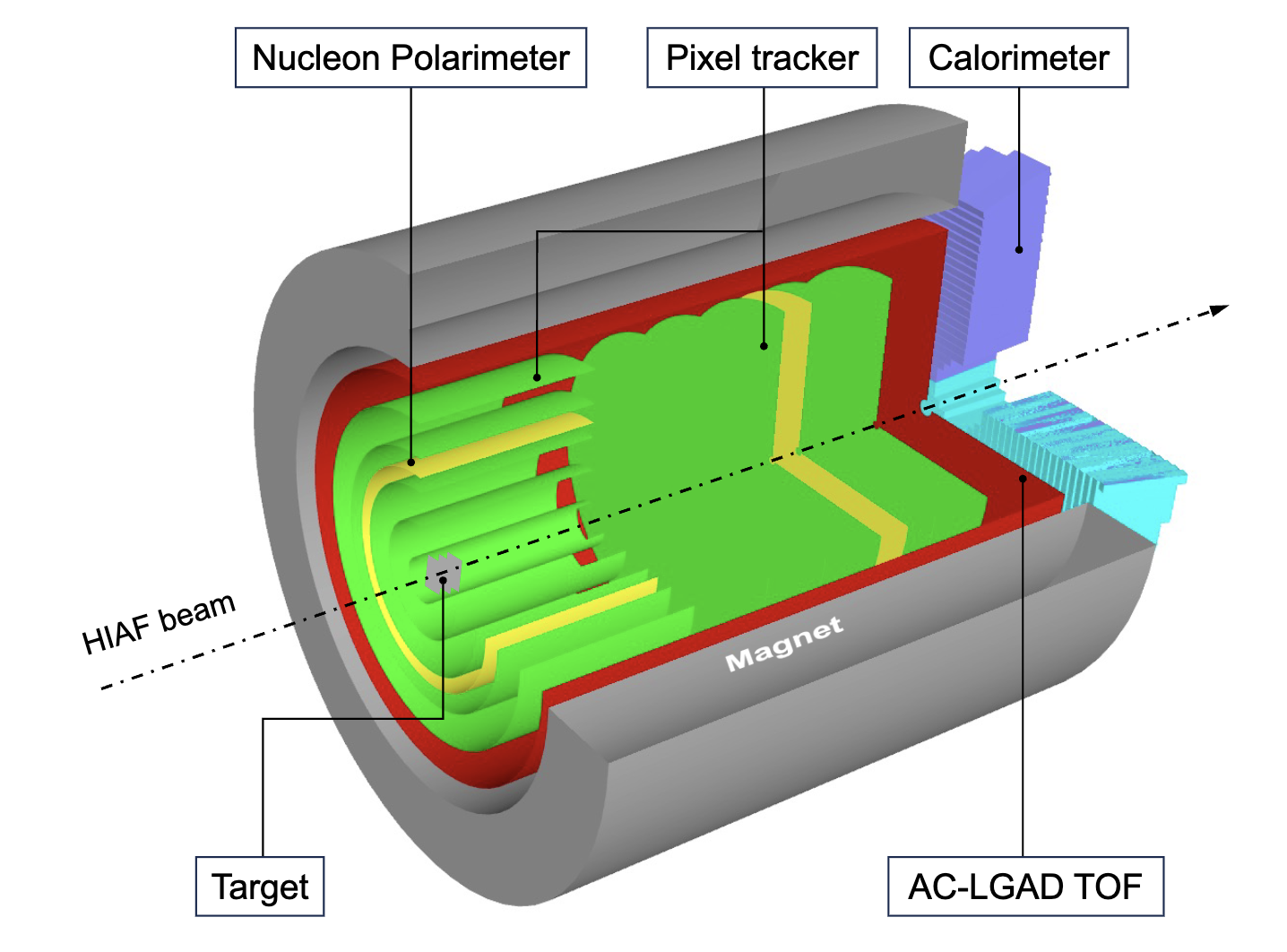
The Nucleon Structure Group focuses on the frontiers of hadron physics, conducting research on nucleon structure and hadron spectroscopy. Currently, the group is leading the construction of the Hyperon-Nucleon Spectrometer (HNS) at the High Intensity heavy ion Accelerator Facility (HIAF). This spectrometer will conduct proton-proton, proton-nucleus, and heavy-ion collision experiments to precisely measure the production cross sections and polarization of Λ, Σ hyperons, systematically investigating spin structure evolution from nucleon to hyperon, cold nuclear matter effects, and hot nuclear matter effects, providing crucial data for both heavy-ion physics and hadron structure research communities. The HNS project will develop advanced technologies including high-position-resolution silicon trackers and ultra-fast AC-LGAD detectors, serving as a technology validation platform for major facilities such as the Electron Ion Collider in China (EicC).
The group has long been actively engaged in international collaborations while promoting the proposed EicC project. Through the synergistic advancement of both the HNS and EicC experimental platforms, the group is dedicated to achieving breakthrough progress in the frontier field of hadron physics.
Research Fields
1: Theoretical and experimental study on nucleon structure.
1-D spin structure, 3-D nucleon internal structure (TMDs, GPDs), nuclear internal structure, proton mass decomposition, exotic states.
2: Theoretical and experimental study on hadron spectroscopy.
Light hadron spectroscopy, exotic states. Participate in BESIII, PANDA, and STCF (Super Tau-Charm Facility in China).
3: Promote the H-NS and EicC project at HIAF and R&D of advanced detector technologies.
Achievements
1. X. Cao, et al. "Electron Ion Collider in China", Nuclear Techniques, 43 No. 2 (2020)
Photos
Contact
Contact: ZHAO Yuxiang
Email: zhaoyx@impcas.ac.cn

Copyright © Institute of Modern Physics, Chinese Academy of SciencesAddress:509 Nanchang Rd., Lanzhou 730000, ChinaEmail: office@impcas.ac.cn
陇ICP备2023003351号-1  甘公网安备 62010202000713号


