

Nuclear Matter Phase Structure Group
Brief Introduction
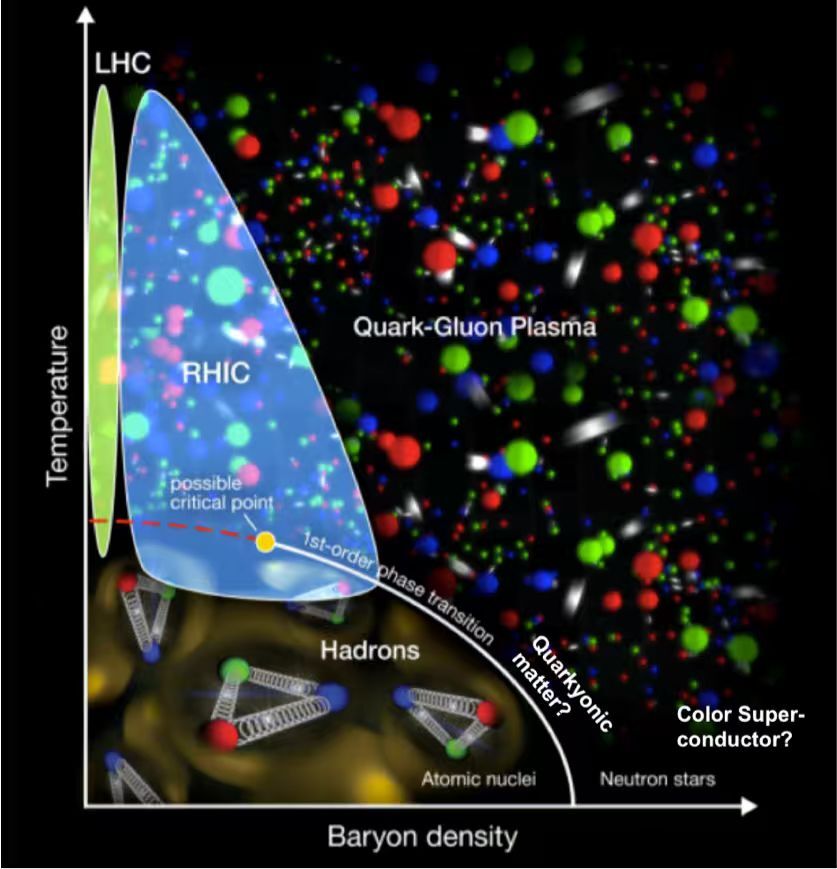
Like common matter (such as water), nuclear matter, described by quantum chromodynamics (QCD), may also have various different states and phase transitions among them. This phase structure of nuclear matter is our research focus. For example, at the extremely high temperature in the early universe, the quarks and gluons which are usually confined in hadrons (such as protons and neutrons) were liberated to form a new state of matter: Quark-Gluon Plasma (QGP).
In the laboratory, we can use relativistic heavy-ion collisions to generate and study QGP. The QGP that we produced in the experiments can reach high temperature of several trillion degrees, which is the highest temperature ever produced by humans. Studies have found that QGP exhibits very low viscosity, which is close to the ideal fluid. Relativistic heavy-ion collisions also provide an ideal laboratory to study the effects of extreme environments such as extremely strong magnetic field (~ 1018 Gauss) and extremely high vorticity (~ 1022 s-1). With lower collision energies, the created nuclear matter have larger baryon density and baryon chemical potential, and there may be some interesting phase transitions, such as the first-order phase transition and critical point.
The Nuclear Matter Phase Structure group studies the properties of QGP, the equation of state of nuclear matter, and searches for the first-order phase transition and critical point in the QCD phase diagram, with both theoretical efforts and heavy-ion collision experiments at home and abroad. These results will help understand the evolution of our universe from the Big Bang to compact stars (e.g. neutron stars).
Research Fields
Theoretical research on the phase structure of nuclear matter.
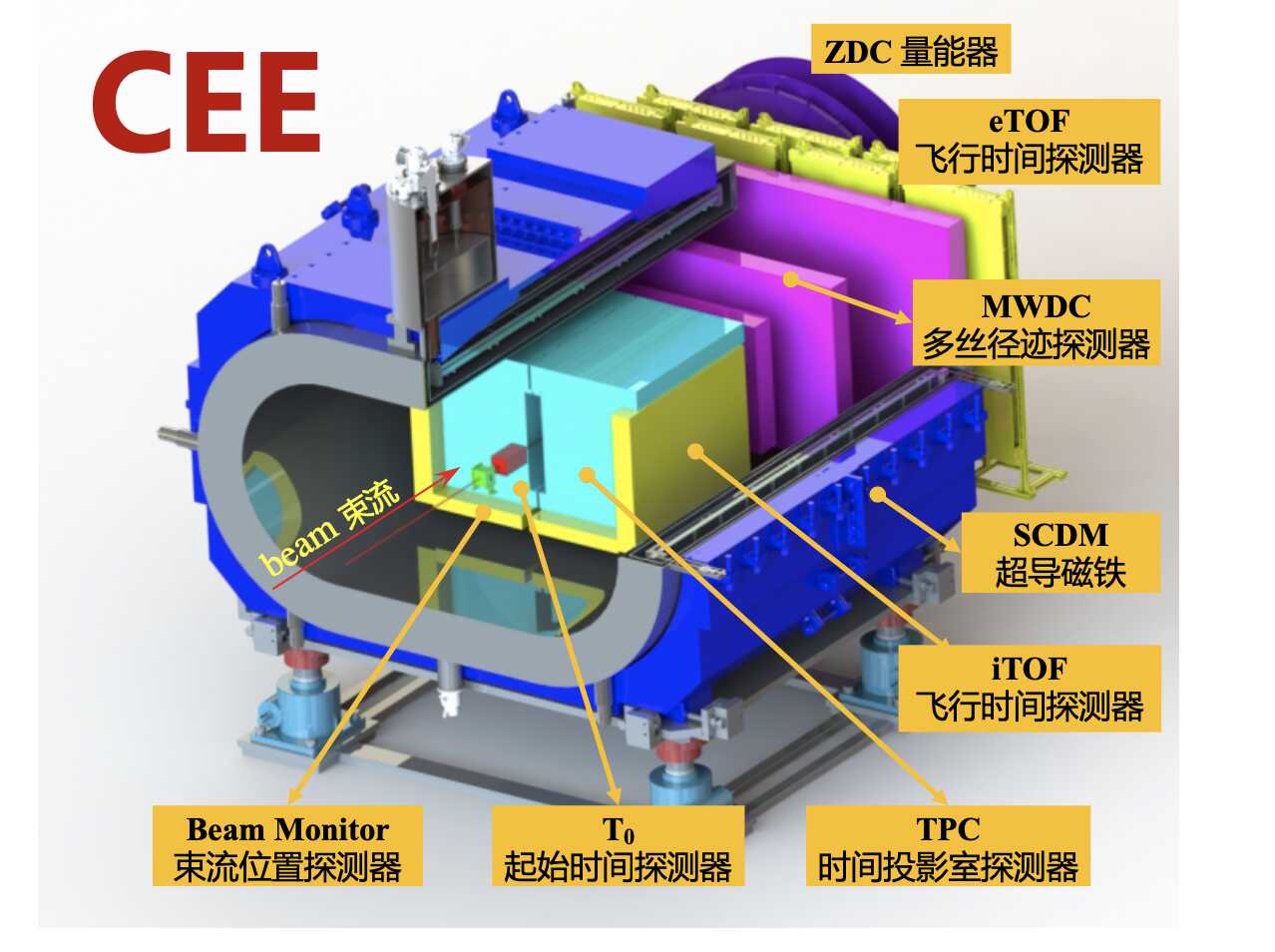
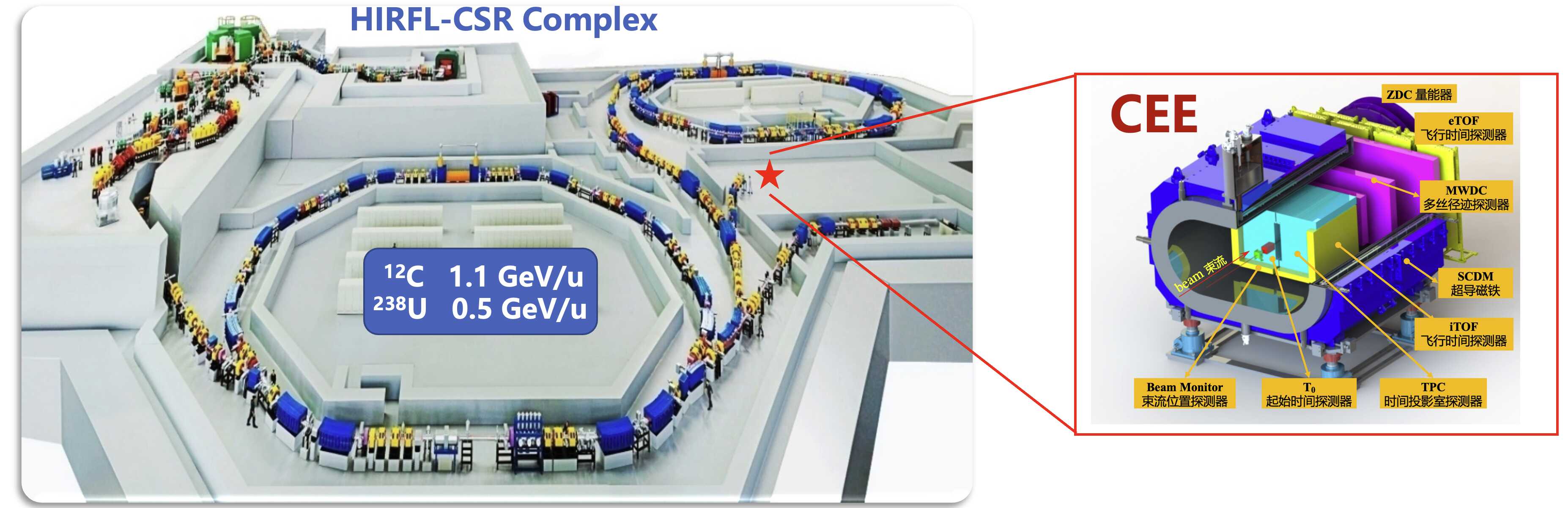
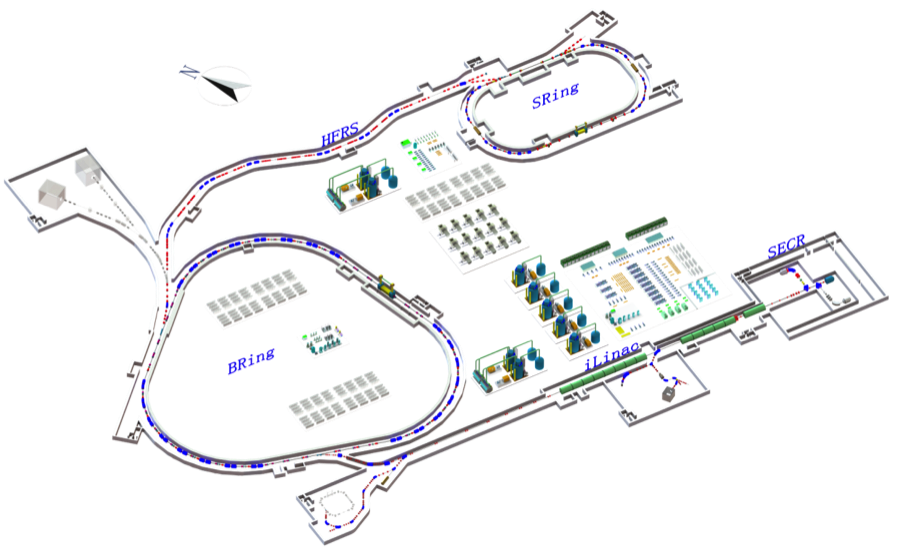
Construction of the CSR External-target Experiment (CEE). CEE is based on the large scientific facility HIRFL-CSR. In the near future, it can also be used at the HIAF facility, which is at Huizhou, Guangdong province. It will be the first world-class large-scale nuclear physics experiment operating in the GeV energy region in China.
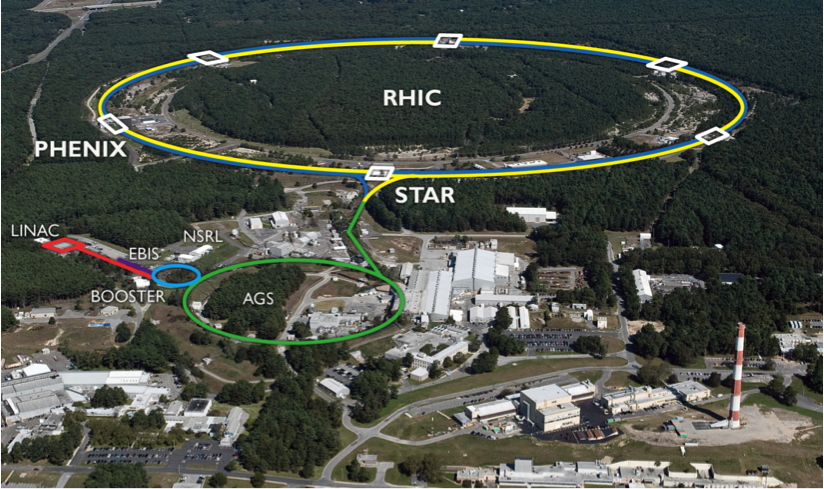
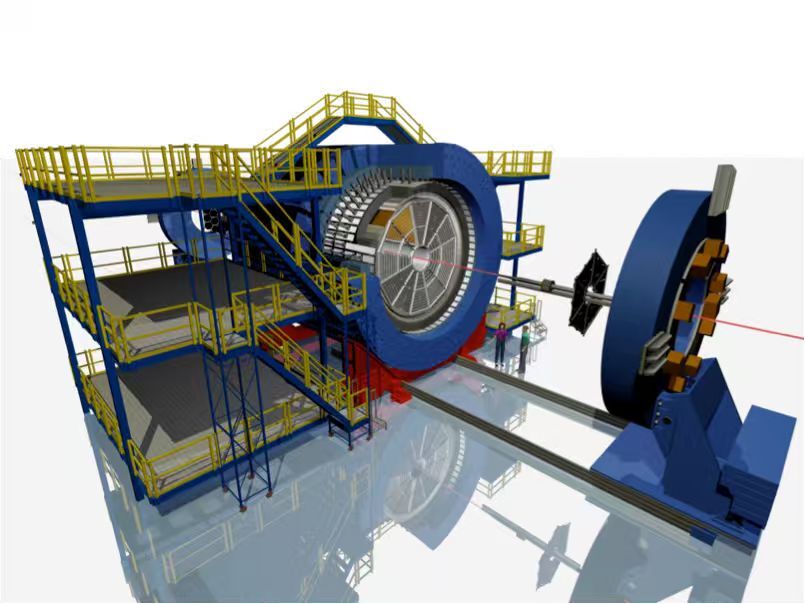
Participate in large international collaborations of heavy-ion collision experiments, such as the STAR experiment at the RHIC collider at the Brookhaven National Laboratory in the United States, and the CBM experiment at the FAIR facility at GSI in Germany.
Achievements
STAR Collaboration, Observation of the antimatter hypernucleus, Nature, 632, 1026 (2024)
STAR collaboration, Observation of the Electromagnetic Field Effect via Charge-Dependent Directed Flow in Heavy-Ion Collisions at the Relativistic Heavy Ion Collider, Phys. Rev. X 14, 011028 (2024).
STAR Collaboration, Pattern of global spin alignment of ϕ and K∗0 mesons in heavy-ion collisions, Nature 614, 244 (2023).
M. Pradeep, K. Rajagopal, M. Stephanov and Yi Yin, Freezing out fluctuations in Hydro+ near the QCD critical point, Phys. Rev. D 106 (2022) no.3, 036017.
J. Brewer, B. Scheihing-Hitschfeld and Yi Yin, Scaling and adiabaticity in a rapidly expanding gluon plasma, JHEP 05 (2022), 145.
N. Sogabe and Y. Yin, Off-equilibrium non-Gaussian fluctuations near the QCD critical point: an effective field theory perspective, JHEP 03 (2022), 124.
STAR Collaboration, Light nuclei collectivity from √sNN = 3 GeV Au+Au collisions at RHIC, Phys. Lett. B 827 (2022) 136941.
Noriyuki Sogabe, Naoki Yamamoto and Yi Yin, Positive magnetoresistance induced by hydrodynamic fluctuations in chiral media, JHEP, 09, 131 (2021).
Baochi Fu, Shuai Liu, LongGang Pang, Huichao Song and Yi Yin, Shear-Induced Spin Polarization in Heavy-Ion Collisions, Phys. Rev. Lett. 127 (2021) 14, 142301.
Shuai Liu and Yi Yin, Spin polarization induced by the hydrodynamic gradients, JHEP 07 (2021) 188.
Shuai Liu and Yi Yin, Spin Hall effect in heavy-ion collisions, Phys. Rev. D 104 (2021) 5, 054043.
Li Yan, J. Brewer and Yi Yin, Adiabatic hydrodynamization in rapidly-expanding quark gluon plasma, Phys. Lett. B 816 (2021) 136189.
Md. Rihan Haque, Subhash Singha*, Bedangadas Mohanty, Probing the profile of bulk matter in p+Pb collisions via directed flow heavy quarks, Phys. Rev C. 104, 024901 (2021).
STAR Collaboration, Beam-energy dependence of the directed flow of deuterons in Au+Au collisions, Phys. Rev. C 102, 044906 (2020).
Shuai Y. F. Liu, Yifeng Sun, and Che Ming Ko, Spin Polarizations in a Covariant Angular-Momentum-Conserved Chiral Transport Model, Phys. Rev. Lett. 125, 062301 (2020)
Krishna Rajagopal, Gregory W. Ridgway, Ryan Weller, and Yi Yin, Understanding the out-of-equilibrium dynamics near a critical point in the QCD phase diagram, Phys. Rev. D 102, 094025 (2020).
Liu, S.Y., Rapp, R., Nonperturbative effects on radiative energy loss of heavy quarks, JHEP 08, 168 (2020).
Shanshan Cao, Kai-Jia Sun, Shu-Qing Li, Shuai Y.F. Liu, Wen-Jing Xing, Guang-You Qin, Che-Ming Ko, Charmed hadron chemistry in relativistic heavy-ion collisions, Phys. Lett. B 807, 135561 (2020).
Lipei Du, Ulrich Heinz, Krishna Rajagopal, and Yi Yin, Fluctuation dynamics near the QCD critical point, Phys. Rev. C 102, 054911 (2020).
Subhash Singha received the 2020 RHIC & AGS Achievement Award from the Brookhaven National Laboratory.
Photos
Contact
Dr. QIU Hao
Email: qiuh@impcas.ac.cn

Copyright © Institute of Modern Physics, Chinese Academy of SciencesAddress:509 Nanchang Rd., Lanzhou 730000, ChinaEmail: office@impcas.ac.cn
陇ICP备2023003351号-1  甘公网安备 62010202000713号


