

Physicists Predict Cluster Radioactivity in Naturally Occurring Isotopes
Naturally occurring isotopes are often considered stable for most practical purposes. However, scientists suggest that cases of rare radioactivity may remain hidden in nature.
In a recent study published in Physics Letters B, physicists have predicted 12 naturally occurring candidate nuclei for cluster radioactivity that are expected to be observable in future experiments.
The study was conducted by researchers from the Heavy Ion Science and Technology Key Laboratory, the Institute of Modern Physics (IMP) of the Chinese Academy of Sciences (CAS), and the KTH Royal Institute of Technology in Sweden.
Cluster radioactivity refers to a process in which an atomic nucleus emits a cluster composed of several nucleons. The helium-4 nucleus, or alpha particle, is the most common emitted cluster, while heavier nuclei such as carbon-14 and oxygen-20 can also be emitted. Experimental studies over the past two decades of alpha radioactivity in natural isotopes, such as bismuth-209 and tungsten-180, have shown that some apparently stable nuclei can still undergo extremely long-lived decays.
"Since naturally occurring isotopes are often available in large quantities and are suitable for long-term low-background measurements, they provide a favorable platform for searching for rare cluster radioactivity," said Dr. ZHANG Wenqiang from IMP.
The researchers performed the first systematic investigation of cluster radioactivity in all even-even naturally occurring isotopes using the universal decay law. They predicted 12 alpha-decay candidates, among which hafnium-176 has the shortest predicted half-life of about 2.79×10¹⁸ years, making it one of the most promising targets for future observation of natural alpha decay.
For heavier cluster radioactivity, the study adopted 1030 years as an ideal upper limit. It was found that osmium-186, which emits the doubly magic calcium-48 cluster, is the only even-even naturally occurring nucleus below the Z=82 shell closure with a predicted half-life below this limit. This makes osmium-186 one of the most noteworthy natural candidates for heavy-cluster decay searches.
Furthermore, the study revealed that natural alpha emitters below Z=82, characterized by extremely low alpha-decay energies, can provide a stringent test of semiempirical decay laws.
"These findings provide a roadmap for future searches for new long-lived cluster-radioactive nuclei. Once the alpha decays of these nuclei are experimentally confirmed, they will provide critical data for testing semiempirical decay laws under extremely low decay-energy conditions," said Dr. QI Chong from the KTH Royal Institute of Technology.
DOI:https://doi.org/10.1016/j.physletb.2026.140559
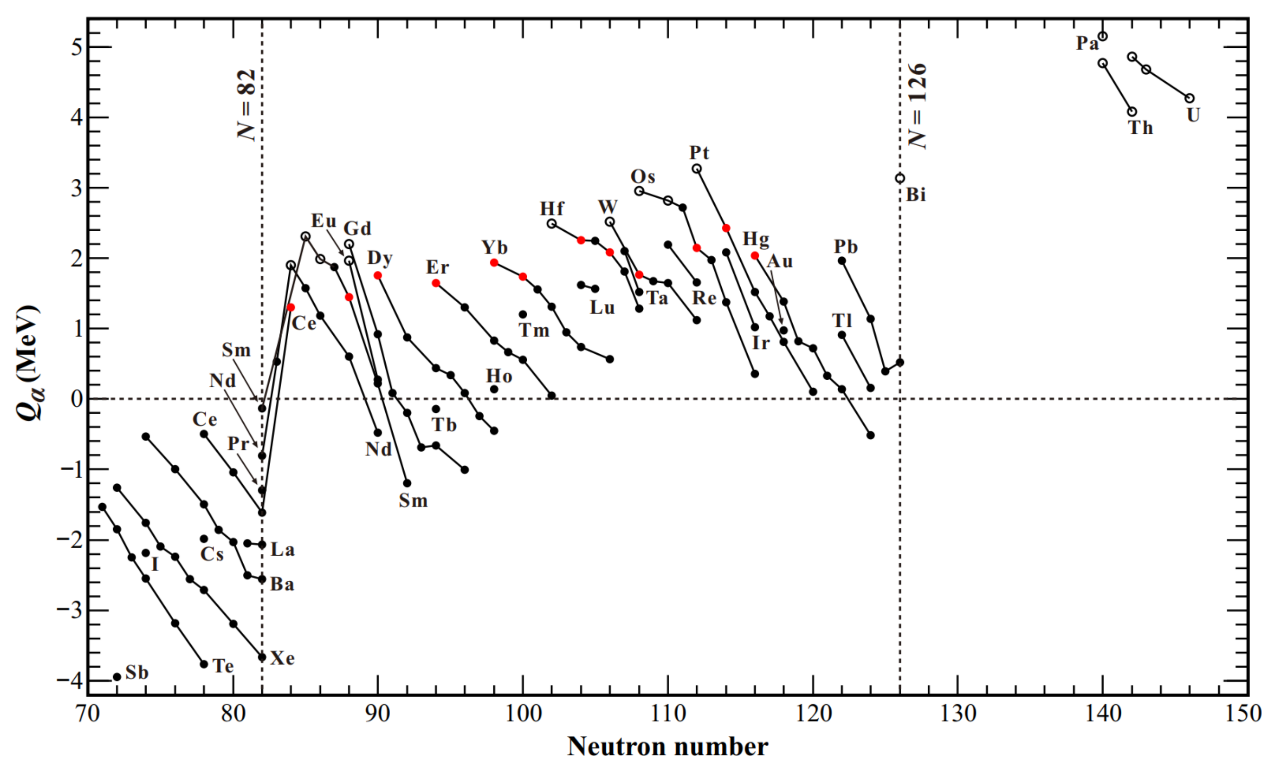
Figure. Alpha-decay energies and candidate nuclei among naturally occurring isotopes. (Image from IMP)
Contact Information
Institute of Modern Physics
Email: ZHANG Wenqiang
Related Articles

Copyright © Institute of Modern Physics, Chinese Academy of SciencesAddress:509 Nanchang Rd., Lanzhou 730000, ChinaEmail: office@impcas.ac.cn
陇ICP备2023003351号-1  甘公网安备 62010202000713号


