

Researchers Develop Quantum-classical Hybrid Computational Framework for Many-fermion Response and Structure
An international research team has developed a quantum-classical computational framework for studying many-fermion response and structure. The new approach, published in Physics Letters B, integrates quantum computing with classical computing techniques to pave the way for resolving the long-standing bottleneck that has limited ab initio calculations of strongly interacting systems.
Response functions are fundamental physical observables for probing the structural and dynamical properties of strongly correlated quantum many-body systems, with extensive applications in nuclear physics, quantum chemistry and other fields.
However, the dimension of the Hilbert space for such strongly correlated quantum many-body problems grows exponentially with the number of particles, making ab initio calculations for systems beyond moderate size intractable even for the most powerful classical computers.
Quantum computing, which is naturally suited for large-scale computations in quantum many-body physics, offers a promising avenue to overcome this bottleneck. The development of quantum computing technologies, as well as theories and algorithms tailored for quantum many-body problems, is currently one of the cutting-edge research focuses in the interdisciplinary field of nuclear physics and quantum computing worldwide.
The researchers from the Institute of Modern Physics (IMP) of the Chinese Academy of Sciences (CAS) and their collaborators constructed an efficient and scalable quantum-classical hybrid framework for solving large-scale many-fermion problems. Incorporating a low-overhead quantum encoding scheme independently developed by the team, this framework significantly reduces the cost of circuit compilation. It also enables a unified self-consistent calculation of the full bound-state spectra and response functions of many-fermion systems under realistic nuclear interactions.
To validate the effectiveness of the new framework, the researchers performed precise calculations of the excitation energy spectra of oxygen-19. The results demonstrate that the calculations from this framework agree with those obtained from classical computations.
The researchers noted that this adaptable framework opens a new path for ab initio studies of nuclear structure and nuclear reactions, while also provides support for the application of quantum computing in the field of strongly correlated many-body systems.
This work was carried out jointly by IMP, the Guangdong Laboratory of Advanced Energy Science and Technology, Iowa State University, and the Lawrence Berkeley National Laboratory.
DOI: https://doi.org/10.1016/j.physletb.2026.140538
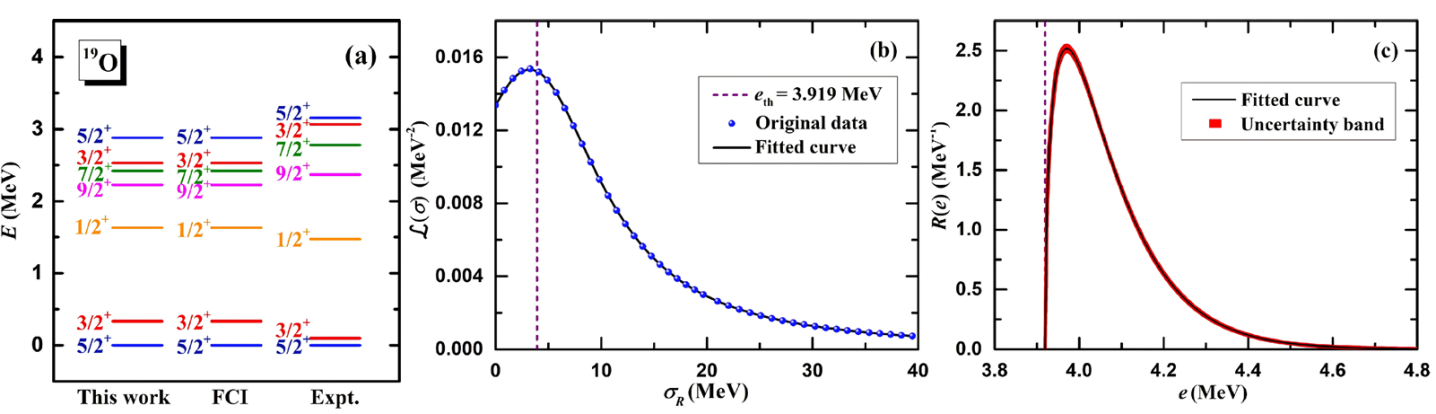
Figure. (a) Excitation spectrum of oxygen-19. The total angular momentum and parity are shown with each state. The results from the full-configuration interaction (FCI) calculations on classical computers and from the experiment are also shown for comparison. (b) The Lorentz integral as a function of σR of oxygen-19. (c) Response function R(e) of oxygen-19 as a function of the excitation energy e. (Image from IMP)
Contact Information
Institute of Modern Physics
Email: LIU Fang
Related Articles

Copyright © Institute of Modern Physics, Chinese Academy of SciencesAddress:509 Nanchang Rd., Lanzhou 730000, ChinaEmail: office@impcas.ac.cn
陇ICP备2023003351号-1  甘公网安备 62010202000713号


