

Scientists Discover Two New Isotopes
Scientists from the Institute of Modern Physics (IMP) of the Chinese Academy of Sciences (CAS) and their collaborators have successfully synthesized two new isotopes, berkelium-235 and americium-231, at the Heavy Ion Research Facility in Lanzhou. Their findings, published in Physics Letters B, provide critical experimental data for the study of neutron-deficient actinide nuclei.
The synthesis and study of new isotopes represent a frontier research area in nuclear physics, offering crucial insights into the limits of nuclear existence, the validation of nuclear mass models, and the exploration of exotic decay modes. In the neutron-deficient berkelium region, the experimental synthesis and identification of new isotopes face a series of challenges due to low fission barriers, extremely small production cross-sections, and the competition among several decay modes.
The researchers conducted the experiment at the platform of the China Accelerator Facility for Superheavy Elements (CAFE2). They used a high-intensity beam of argon-40 to bombard a gold-197 target. Through fusion-evaporation reactions and separation with a gas-filled recoil separator, they successfully observed berkelium-235 and its α-decay daughter nucleus, americium-231, for the first time.
Using the advanced atom-at-a-time detection technique, researchers identified three correlated α-decay chains. They measured the α-particle energy of berkelium-235 to be 7632 keV. For americium-231, the α-particle energy and half-life were determined to be 7109 keV and 75 seconds, respectively. Based on the observed decay chains, the researchers also estimated the α-decay branching ratio of americium-231 as 17%. The results considerably extend the α-decay systematics in the region of neutron-deficient actinide nuclei.
Notably, the study provides a systematic comparison between experimental α-decay energies and predictions from theoretical mass models in the actinide region. The results reveal that, for neutron-deficient berkelium and americium isotopes, the theoretical values are systematically higher than the experimental ones, with significant discrepancies in the predicted trend for berkelium isotopes. These findings offer essential experimental constraints for optimizing theoretical models.
The research was led by IMP and the State Key Laboratory of Heavy ion science and Technology, in collaboration with the Advanced Energy Science and Technology Guangdong Laboratory, the Institute of Theoretical Physics of CAS, Tongji University, Shandong University, Guangxi Normal University, the University of York (UK), and the Joint Institute for Nuclear Research (Russia).
The work was supported by the National Key R&D Program of China, the Strategic Priority Research Program of CAS, the Guangdong Major Project of Basic and Applied Basic Research, the National Natural Science Foundation of China, the Gansu Key Project of Science and Technology, the CAS President's International Fellowship Initiative, and the Russian Science Foundation, among others.
DOI: https://doi.org/10.1016/j.physletb.2026.140365
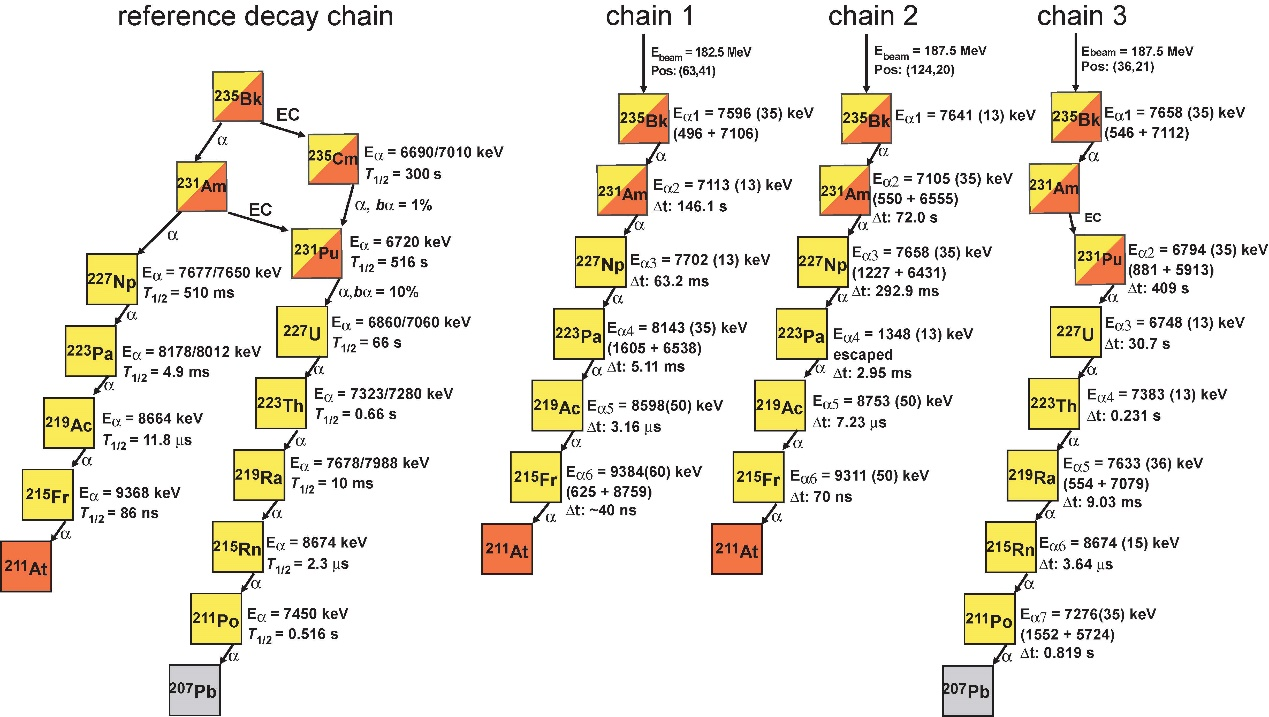
Figure 1. The decay chains of berkelium-235. (Image from Physics Letters B)

Figure 2. The gas-filled recoil separator SHANS2 (Spectrometerfor Heavy Atoms and Nuclear Structure-2). (Image from IMP)
Contact Information
Institute of Modern Physics
Email: LIU Fang
Related Articles

Copyright © Institute of Modern Physics, Chinese Academy of SciencesAddress:509 Nanchang Rd., Lanzhou 730000, ChinaEmail: office@impcas.ac.cn
陇ICP备2023003351号-1  甘公网安备 62010202000713号


