
Researchers Uncover Key Physical Mechanism Restricting Self-Adaptive Guiding of Fast Ion Beams
An international research team led by the Institute of Modern Physics (IMP) of the Chinese Academy of Sciences (CAS) has achieved advances in ion beam manipulation technology, overcoming a long-standing obstacle in the development of a self-adaptive, self-powered ion beam guide.
Their findings were published in Physical Review Letters on March 9. The study has uncovered the key physical mechanism limiting the guiding of fast ion beams and realized stable guiding of such beams.
Ion beams play a critical role in scientific research, advanced manufacturing, cancer therapy, mutation breeding and microbial engineering. Conventional ion beam transport depends on fixed vacuum beam lines, electromagnetic lenses and related power supplies and control systems. For decades, scientists have aimed to develop an ion beam guide similar to water pipes or optical fibers. Such a device could enable self-adaptive ion beam transport via self-organized electric fields, removing the need for external power and control systems and broadening applications.
However, the concept has long been limited by a bottleneck. Self-adaptive guiding was previously only possible for low-energy ions with beam currents in the femtoampere-to-picoampere range. For higher-energy beams, the guiding electric field saturates prematurely—making it too weak to control faster ion beams. For higher-current beams, it is often unstable.
"These issues have long hindered the translation of this technology into practical applications," said Associate Prof. XUE Yingli of IMP, first author of the study. "Through in-depth investigation, we have for the first time identified the key mechanism responsible for electric field saturation."
The study reveals that when high-energy ions collide with the inner wall of the guiding channel, they deposit electric charge and simultaneously "sputter"—ejecting large numbers of secondary ions from the surface. These secondary ions are then propelled to the opposite inner wall by the electric field and deposit charge there, weakening the self-organized electric field that guides the ion beam.
To address this problem, the researchers proposed a novel solution and designed a guiding channel featuring a deep-groove structure. The deep grooves prevent secondary ions from escaping, reducing the charge-spraying factor from a maximum of 98% to less than 7%. The team also integrated a hidden resistor network, resolving the unstable conductivity of traditional guiding channels under ion irradiation.
Using these strategies, the researchers achieved stable guiding of an O⁵⁺ ion beam with a current of 386 nA and an energy of 100 keV. Compared with previous results, the guiding potential difference was increased by two orders of magnitude, and the beam current by three orders of magnitude.
"This study has resolved the key problems limiting the self-adaptive guiding of fast ion beams, laying the foundation for the practical realization of the ion beam guide," said Prof. YU Deyang of IMP, corresponding author of the paper.
This work was supported by the National Key Research and Development Program of China and the National Natural Science Foundation of China.
DOI: https://doi.org/10.1103/7vwr-szkt
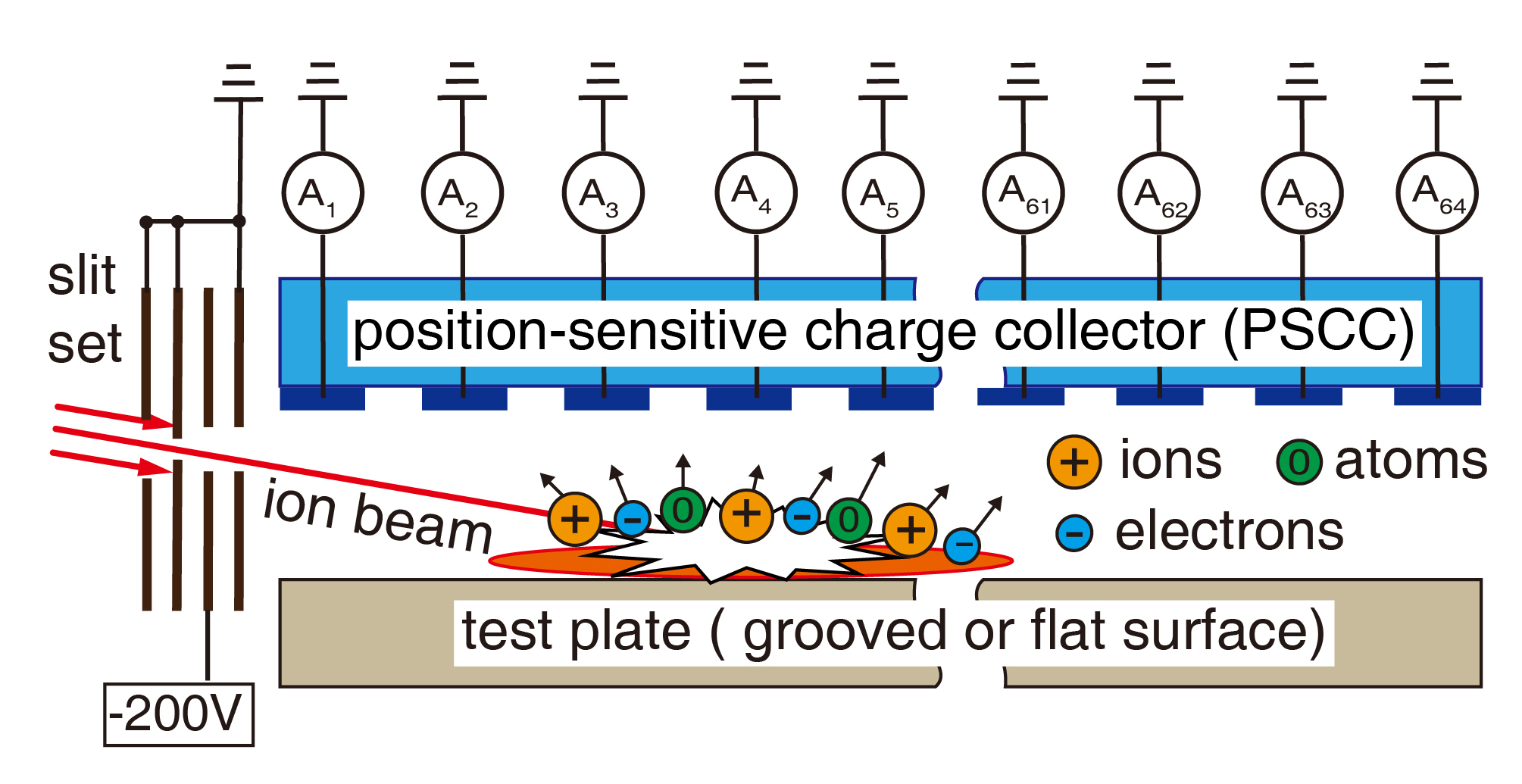
Figure 1. Measurement of spraying-current distributions of secondary ions and electrons induced by a fast ion beam. Charge spraying by the secondary ions is the main cause of premature saturation of the guiding electric field; the groove structure can effectively suppress the charge spraying by secondary ions. (Image by IMP)
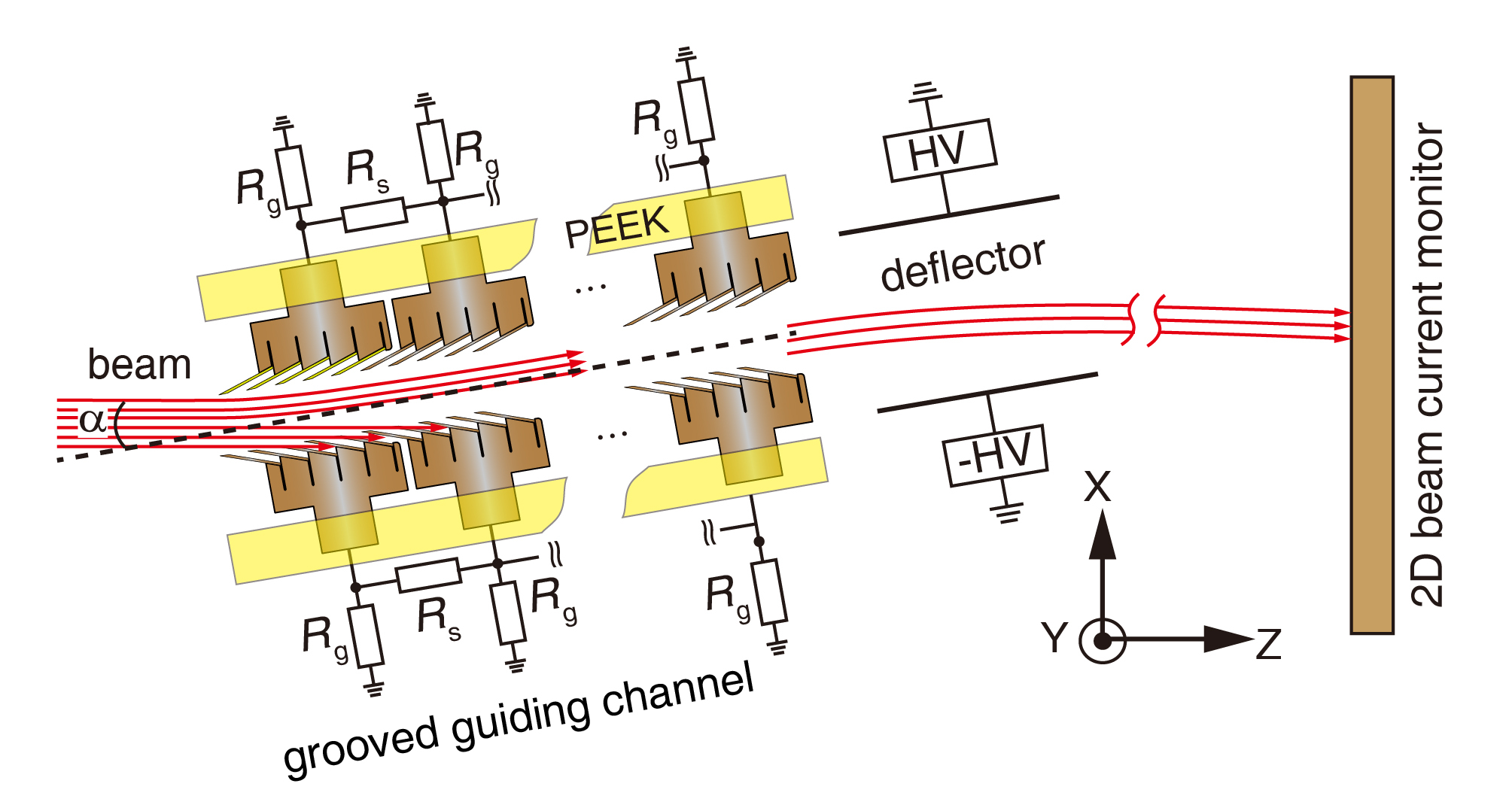
Figure 2. Self-adaptive guiding of fast ion beams is achieved in channels with grooved inner surfaces, but not in those with flat inner surfaces. (Image by IMP)
Contact Information
Institute of Modern Physics
Email: YU Deyang
Related Articles

Copyright © Institute of Modern Physics, Chinese Academy of SciencesAddress:509 Nanchang Rd., Lanzhou 730000, ChinaEmail: office@impcas.ac.cn
陇ICP备2023003351号-1  甘公网安备 62010202000713号


