

Study Reveals Possibility of Photon Bose-Einstein Condensation in Astrophysical Environments
A new study has revealed the possibility of photon Bose-Einstein condensation within astrophysical environments, shedding light on the interaction dynamics between radiation and matter in the early universe.
Conducted by researchers from the Institute of Modern Physics (IMP) of the Chinese Academy of Sciences (CAS), the study was published in The Astrophysical Journal on February 26, 2026.
As one of the fundamental bosons, photons have long been a subject of scientific curiosity regarding their potential to undergo Bose-Einstein condensation, a phenomenon established in ultracold atomic gases. Since Einstein's prediction of Bose condensation in 1924, the question of whether photons can form a condensed state has remained a research frontier.
In 1969, Soviet physicists first proposed an astrophysical context for photon condensation, considering photon scattering with cold electrons in the expanding universe. It was not until 2010 that scientists observed photon Bose-Einstein condensation at room temperature within an optical cavity.
In this study, researchers from IMP introduced a modified Kompaneets equation, extending the classical Kompaneets formalism to scenarios where high-energy photons are comparable to the electron thermal energy.
Using this framework, researchers demonstrated that the interactions between high-energy photons and cold electron gas can facilitate the accumulation of photons toward the low-energy regime, leading to conditions conducive to Bose-Einstein condensation.
"Numerical simulations reveal a gradual accumulation of photons towards the low-energy end under photon-number conservation," said GUO Bingang from IMP, the first author of this study. "This process results in an enhancement of the photon occupation number near zero energy, a signature of Bose-Einstein condensation." Entropy analysis confirms that this condensate corresponds to a thermodynamic equilibrium, representing the maximum entropy state of the system.
However, despite these theoretical indications, the study suggests that in realistic cosmic plasma environments, photon-number non-conserving processes occur on timescales shorter than those required for condensation formation. These absorption mechanisms tend to suppress or prevent the photon condensate from forming in the observable universe. Thus, while the formation of photon Bose-Einstein Condensation remains theoretically feasible, its long-term sustainability in cosmic settings appears unlikely.
"Nonetheless, this work advances our understanding of radiation-matter interactions under extreme conditions, with implications for spectral distortions of the cosmic microwave background and the thermodynamics of primordial plasma," said Prof. CHEN Xurong from IMP, the corresponding author of the paper.
The study reveals photon condensation mechanisms from both kinetic and thermodynamic perspectives. The developed theoretical models and numerical methods offer insights for investigations into Bose-Einstein condensation phenomena, with applications spanning cosmology, high-energy astrophysics, and laboratory plasma physics.
The research was supported by the National Key Research and Development Program of China.
Link to the paper: https://iopscience.iop.org/article/10.3847/1538-4357/ae42cc 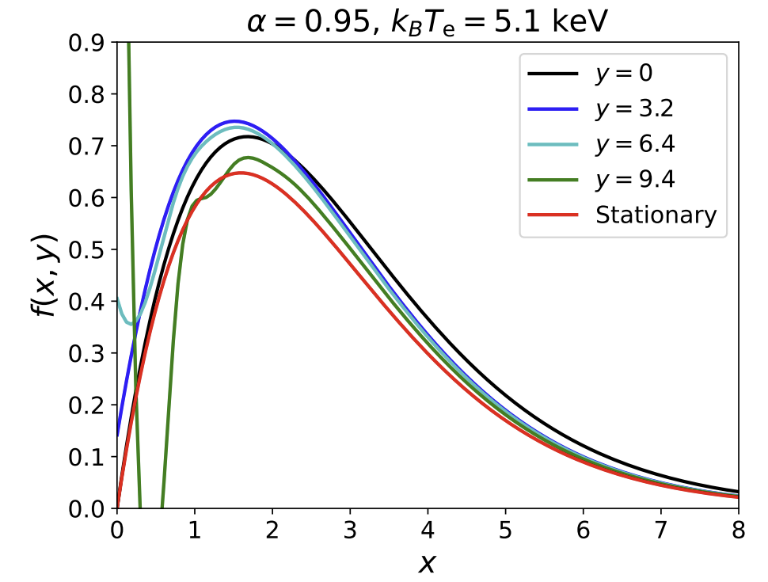
Figure. Numerical simulations of the evolution of the photon distribution over time, based on the modified Kompaneets equation, are presented. (Image from IMP)

Copyright © Institute of Modern Physics, Chinese Academy of SciencesAddress:509 Nanchang Rd., Lanzhou 730000, ChinaEmail: office@impcas.ac.cn
陇ICP备2023003351号-1  甘公网安备 62010202000713号


