

High-Precision Spectroscopy of Highly Charged Ions Tests Quantum Electrodynamics Effects
As an important frontier at the intersection of atomic physics and nuclear physics, precision spectroscopy of highly charged ions serves as a powerful tool for testing quantum electrodynamics (QED) effects under extreme electromagnetic fields and for probing nuclear structure.
A joint research team, consisting of scientists from the Institute of Modern Physics (IMP) of the Chinese Academy of Sciences (CAS), Fudan University, and Saint Petersburg State University, has recently achieved new experimental results in this field. Their findings were published in Physical Review A and Spectrochimica Acta Part B: Atomic spectroscopy.
Hyperfine splitting in highly charged ions arises from electromagnetic interactions between the atomic nucleus and bound electrons. The associated energy-level structures are highly sensitive to nuclear magnetic dipole moments, nuclear electric quadrupole moments, and strong-field QED corrections, making them important observables for investigating nuclear structure and fundamental interactions.
However, precision measurement of these hyperfine structures remains technically challenging, due to the demanding conditions required for ion production and the complexity of multi-electron atomic systems.
Using a high-temperature superconducting electron beam ion trap (EBIT) experimental platform, the researchers observed the hyperfine splitting in boron-like chlorine ions for the first time. They also successfully extracted key nuclear structure information from beryllium-like chlorine ions.
By performing high-precision first-principles theoretical calculations and conducting detailed comparisons with the experimental results, the researchers extracted the nuclear magnetic dipole and electric quadrupole hyperfine constants. The results provide an important experimental benchmark for theoretical studies of hyperfine structure in medium-Z highly charged ions.
Furthermore, researchers carried out high-precision spectroscopic measurements of beryllium-like sulfur and beryllium-like chlorine ions in the extreme ultraviolet (EUV) spectral region. Using a self-developed high-resolution EUV spectrometer to measure electric dipole transitions, they found that the experimental data agree with first-principles QED calculations within the stated uncertainties.
The researchers have also developed a new-generation high-temperature superconducting electron beam ion trap device. Featuring a significantly enhanced electron beam energy range, ion production efficiency and ion extraction capability, the new device will further support advanced precision spectroscopy and frontier research at the interface of atomic and nuclear physics.
The work was supported by the National Natural Science Foundation of China and the National Key R&D Program of China.
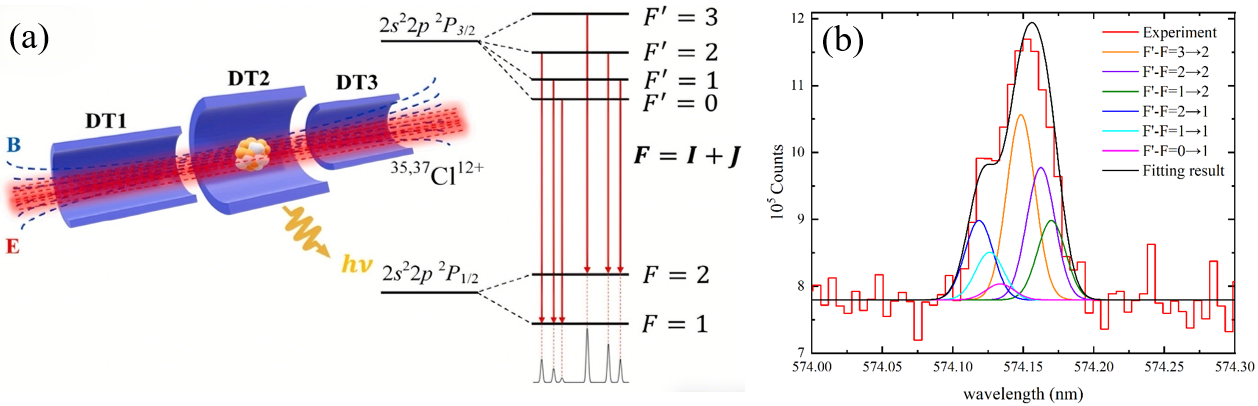
Figure. (a) Energy-level diagram illustrating the bound and emission states of the Cl12+ ion in the SH-HtscEBIT. (b) Emission spectrum of boron-like Cl12+ ions. (Image from IMP)
DOI:
https://doi.org/10.1103/5dls-tz48
https://doi.org/10.1016/j.sab.2025.107349
Contact Information
Institute of Modern Physics
Email: LIU Fang
Related Articles

Copyright © Institute of Modern Physics, Chinese Academy of SciencesAddress:509 Nanchang Rd., Lanzhou 730000, ChinaEmail: office@impcas.ac.cn
陇ICP备2023003351号-1  甘公网安备 62010202000713号


