

Study Provides Experimental Evidence for Uncovering Brain Memory Mechanisms
A research team from the Institute of Modern Physics (IMP), Chinese Academy of Sciences (CAS), in collaboration with Lanzhou University, has obtained important experimental evidence for revealing brain memory mechanisms and developing new-type neuromorphic computing. The findings were published in Advanced Functional Materials.
Human learning and memory originate from the highly dynamic connection structures between neural synapses. These structures act like intelligent switches to transmit signals and undergo dynamic remodeling, thereby enabling the encoding, storage, and retrieval of information, and serving as the biological basis for cognition and behavioral adaptation.
In biological nervous systems, synapses function as natural memristors, relying on the controllable transport of ions and neurotransmitters within nanochannels to process and store information. The key to the brain's ability to perform complex computations with extremely low energy consumption lies in the dynamic adjustment of synaptic connection strength based on prior activity. Replicating this effect through controllable fabrication in liquid systems is crucial for studying neural network functions and advancing the development of brain-computer interfaces and biological neuromorphic computing.
In this study, the researchers demonstrated the memristive effect in bio-inspired nanochannels through two distinct stimulation mechanisms: the divalent ion screening effect and pH-driven deprotonation.
Using the single-ion microbeam facility at the Heavy Ion Research Facility in Lanzhou (HIRFL), the researchers prepared bio-inspired nanopores. Under the combined action of the two mechanisms, ionic transport symmetry breaking and surface effects in the nanopores work in synergy, leading to hysteretic characteristics in ion transport. This nanofluidic memristor also simulates biological memory features, including short-term and long-term potentiation effects, as well as key synaptic functions such as paired-pulse facilitation and paired-pulse depression.
Moreover, the researchers dynamically encoded synaptic weights, a core mechanism for adaptive learning behaviors in neuromorphic systems. To verify its application potential, they constructed a three-layer artificial neural network for pattern recognition and conducted training and testing on a handwritten digit dataset, achieving a recognition accuracy of 94.6%. Its performance is comparable to that of many solid-state memristive synapses.
The paper's first author is Muhammad Jahangeer, a Ph.D. candidate at IMP. Corresponding authors are Prof. DU Guanghua from IMP, and Prof. WANG Qi from Lanzhou University.
This research was supported by the Ministry of Science and Technology, the National Natural Science Foundation of China, and the Scholarship of the University of Chinese Academy of Sciences.
DOI: http://doi.org/10.1002/adfm.202525932
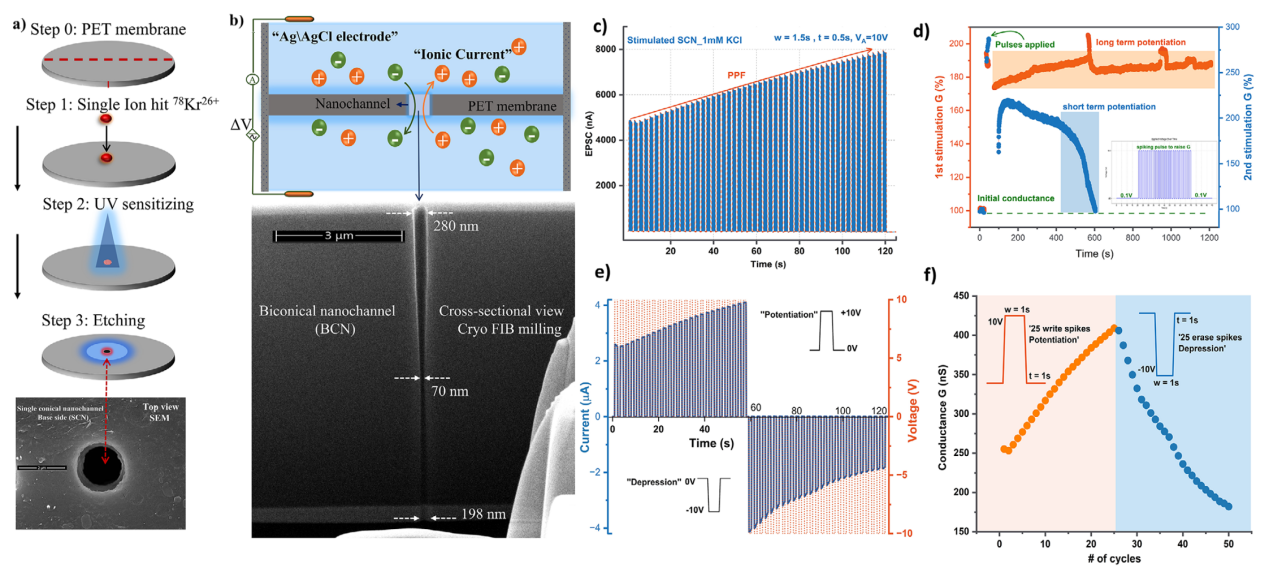
Figure. Structure of the nanofluidic memristor and its synaptic function demonstration. (Image from IMP)
Contact Information
Institute of Modern Physics
Email: LIU Fang
Related Articles

Copyright © Institute of Modern Physics, Chinese Academy of SciencesAddress:509 Nanchang Rd., Lanzhou 730000, ChinaEmail: office@impcas.ac.cn
陇ICP备2023003351号-1  甘公网安备 62010202000713号


