

Beta-decay Half-life Measurements Reveal Evolution of Nuclear Shell Structure
An international team of researchers has systematically measured the β-decay half-lives of 40 nuclei near calcium-54, providing key experimental data for understanding the structure of extremely neutron-rich nuclei.
The study, published in Physical Review Letters, was led by the Institute of Modern Physics (IMP) of the Chinese Academy of Sciences (CAS), in collaboration with institutions including RIKEN in Japan and Peking University.
Atomic nuclei exhibit exceptional stability when the proton number (Z) or neutron number (N) reaches certain "magic numbers", such as 2, 8, 20, 28, 50, 82, 126. The shell model successfully explained these magic numbers by introducing spin-orbit coupling, a contribution for which M. Mayer and J. Jensen were awarded the Nobel Prize in Physics in 1963.
However, recent studies have revealed that traditional magic numbers may vanish and new ones may emerge in regions far from the stability line. For instance, in neutron-rich calcium isotopes, N=32 and 34 have been experimentally confirmed to exhibit subshell effects.
A key question is how these subshell closures at N=32 and 34 evolve in lighter isotopic chains, such as those of potassium and chlorine. "Due to the extremely low production yields of nuclei in this region, it is extremely challenging to investigate the evolution of the nuclear shell structure with traditional methods based on mass measurement or γ-ray spectroscopy," said ZENG Quanbo, a Ph.D. student from IMP and the first author of this paper.
To overcome this challenge, the researchers proposed that β-decay half-lives could serve as a sensitive experimental probe for the evolution of single-particle orbitals in this region. They performed the experiment at the Radioactive Isotope Beam Factory (RIBF) of RIKEN in Japan.
Researchers precisely measured the β-decay half-lives of 40 nuclei around calcium-54. Among these, the half-lives of 10 nuclei were measured for the first time, and the precision for 5 others was significantly improved.
Researchers found two prominent features for the first time. First, a significant drop in the half-life of potassium-54 indicates a subshell effect at N=34, an interpretation supported by shell model calculations. Second, the half-life of chlorine-48 was notably shorter than those of its neighboring isotopes. Researchers suggested that this anomaly stems from the significant neutron excitations across the N=32 subshell in chlorine-48. Further theoretical analysis revealed that this cross-shell excitation primarily results from strong configuration mixing, rather than a significant weakening of the N=32 subshell gap.
The High-Intensity heavy-ion Accelerator Facility (HIAF) in China will soon be operational. "Taking advantage of its high beam intensity and high energy, HIAF will be capable of efficiently producing unstable nuclei. High-precision β-decay and other spectroscopic measurements of more neutron-rich nuclei conducted at HIAF are expected to further advance our understanding of nuclear shell evolution and promote the development of shell model theories," said Prof. LIU Zhong from IMP.
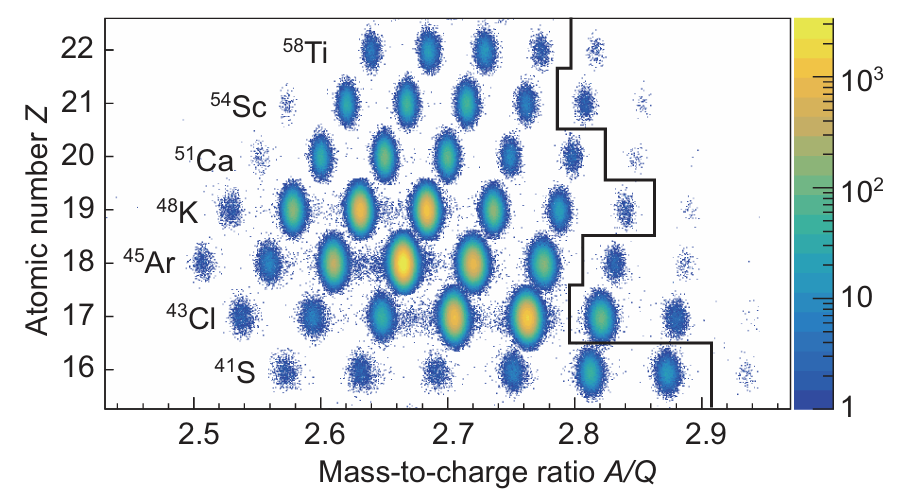
Figure 1. Particle identification plot of the present experiment identified at ZeroDegree spectrometer. The newly measured half-lives correspond to nuclei right of the black line. (Image from IMP)
DOI: https://doi.org/10.1103/227j-q7zf
Contact Information
Institute of Modern Physics
Email: LIU Fang
Related Articles

Copyright © Institute of Modern Physics, Chinese Academy of SciencesAddress:509 Nanchang Rd., Lanzhou 730000, ChinaEmail: office@impcas.ac.cn
陇ICP备2023003351号-1  甘公网安备 62010202000713号


