

Study Sheds New Light on Reaction Dynamics of Weakly Bound Nuclei
A study led by researchers at the Institute of Modern Physics (IMP) of the Chinese Academy of Sciences (CAS) has provided critical experimental data that advances our understanding of reaction dynamics and exotic nuclear structures of weakly bound nuclei. The findings were published in Physics Letters B.
Weakly bound nuclei are characterized by their extremely low binding energy of protons and neutrons. Investigating their reaction mechanisms and exotic structures represents a frontier field in nuclear physics.
Among weakly bound nuclei, the neutron-halo nucleus beryllium-11 and the proton-halo nucleus boron-8 have attracted particular interest. Due to their exceptionally low binding energies and unique nuclear structures, they demonstrate strong coupling effects in nuclear reactions. In particular, the breakup coupling significantly influences elastic scattering. Understanding these effects is crucial for unraveling the structure and reaction mechanisms of atomic nuclei.
The experiment was performed at the Radioactive Ion Beam Line in Lanzhou (RIBLL) at the Heavy Ion Research Facility in Lanzhou (HIRFL). The researchers bombarded a nickel-58 target with secondary beams of beryllium-7, -10, -11 and boron-8, measuring the angular distributions of elastic scattering at energies approximately six times the Coulomb barrier.
By analyzing the experimental data with theoretical calculations, the researchers found that the elastic scattering angular distribution of beryllium-11 exhibits significant suppression of the Coulomb-nuclear interference peak due to the breakup coupling, indicating strong coupling effects caused by its neutron-halo structure. In contrast, despite having a lower binding energy, boron-8 exhibits much weaker coupling effects than beryllium-11, as the Coulomb and centrifugal barriers suppress the breakup probability of its valence proton.
Researchers also found that elastic scattering behaviors of beryllium-7 and beryllium-10 are similar to those of typical weakly bound isotopes, but their coupling effects are notably weaker.
Furthermore, the results indicate that coupling effects intensify with increasing mass number of the target nucleus, a trend validated by scattering data of beryllium-11 and boron-8 on different targets.
“From both experimental and theoretical perspectives, we have successfully completed a systematic investigation of coupling effects in elastic scattering for neutron-halo and proton-halo nuclei at energies above the Coulomb barrier, which provides important insights into the reaction mechanisms of weakly bound nuclei,” said Associate Prof. WANG Kang from IMP, the first author of this paper.
The study was conducted in collaboration with researchers from Beihang University and Anhui University.
This work received support from multiple projects, including the National Key R&D Program of China and the National Natural Science Foundation of China.
DOI: https://doi.org/10.1016/j.physletb.2025.139957
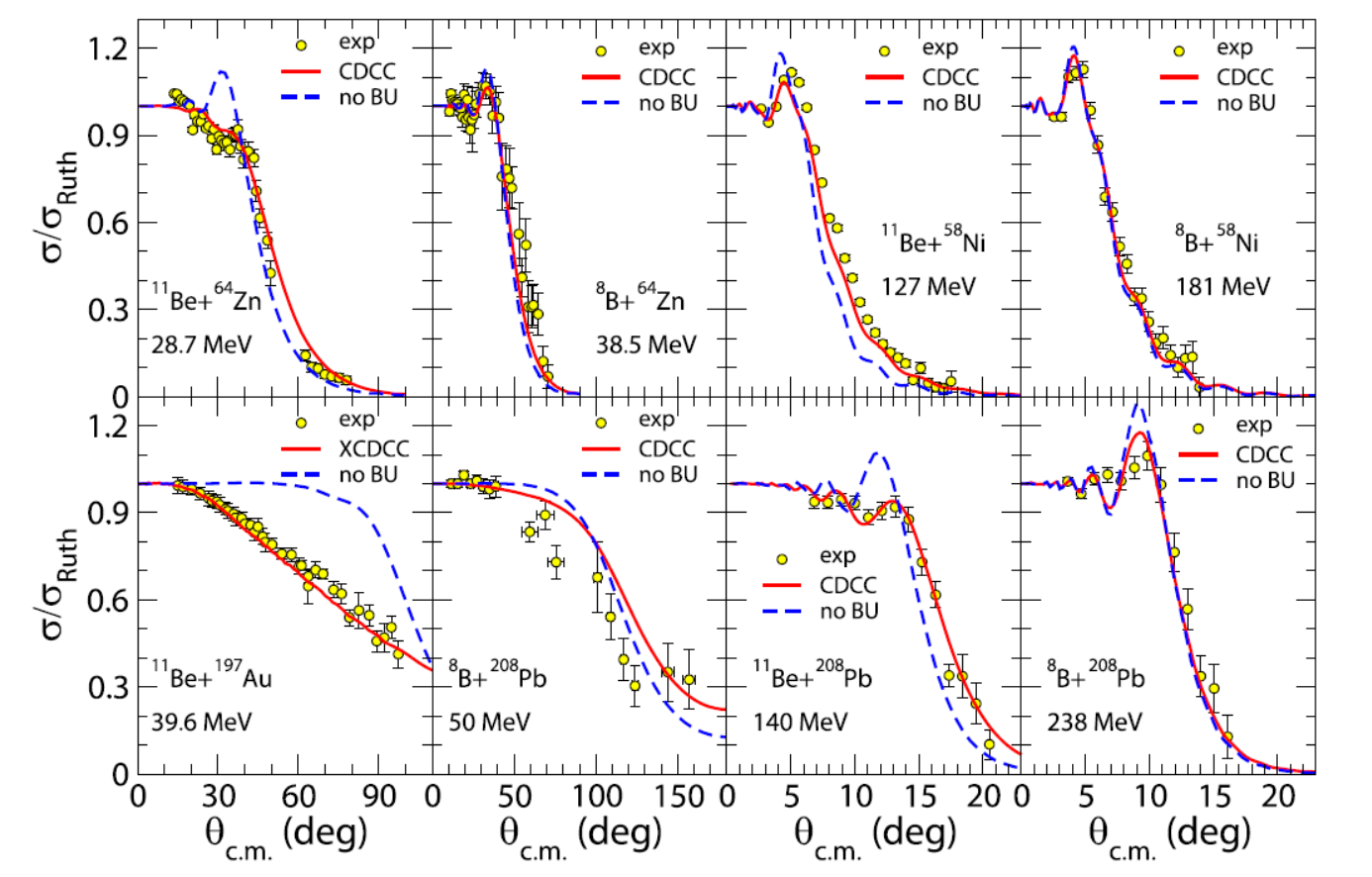
Figure. Comparison of elastic scattering differential cross sections of beryllium-11 and boron-8 on different targets at various energies with theoretical calculations. (Image by IMP)
Contact Information
Institute of Modern Physics
Email: LIU Fang
Related Articles

Copyright © Institute of Modern Physics, Chinese Academy of SciencesAddress:509 Nanchang Rd., Lanzhou 730000, ChinaEmail: office@impcas.ac.cn
陇ICP备2023003351号-1  甘公网安备 62010202000713号


