

Researchers Develop Deep-learning System for Quench Detection in Superconducting Magnets
Researchers have developed an Artificial Intelligence Quench Detection System (AI-QDS) that can distinguish genuine quenches from magnetic interference within milliseconds, offering a new means of protection for superconducting magnets used in large-scale scientific facilities.
The study, led by researchers from the Institute of Modern Physics (IMP) of the Chinese Academy of Sciences (CAS), was published in Superconductor Science and Technology.
Superconducting magnets are critical components in large-scale scientific facilities such as particle accelerators and fusion devices. When a quench (a sudden loss of superconductivity) occurs, the affected region heats up rapidly and may cause permanent damage to the coil unless protective measures are activated within tens of milliseconds. In addition, a phenomenon called "flux jumping" generates electrical disturbances that closely resemble real quench signals, frequently triggering false alarms in conventional detection systems.
To tackle this problem, the researchers at IMP developed AI-QDS by training a convolutional neural network on years of historical quench data. The deep-learning-based model learns subtle differences between genuine quenches and flux-jump interference, enabling fast and accurate identification.
In validation tests on a prototype superconducting magnet of the Fourth-generation Electron Cyclotron Resonance (FECR) ion source for the High Intensity heavy-ion Accelerator Facility (HIAF), AI-QDS maintained stable and reliable operation under intense electromagnetic noise. It successfully detected all three quench events, even though more than 1,000 cumulative flux jumps occurred during the magnet excitation process.
These results demonstrate the feasibility and effectiveness of deep learning-based online quench detection in harsh electromagnetic environments. The study suggests that AI-QDS holds potential for applications in superconducting magnets protection and can serve as a practical solution for enhancing the safety of large-scale scientific facilities.
This work was supported by the National R&D Program for Major Research Instruments.
DOI: https://doi.org/10.1088/1361-6668/aeaf1c
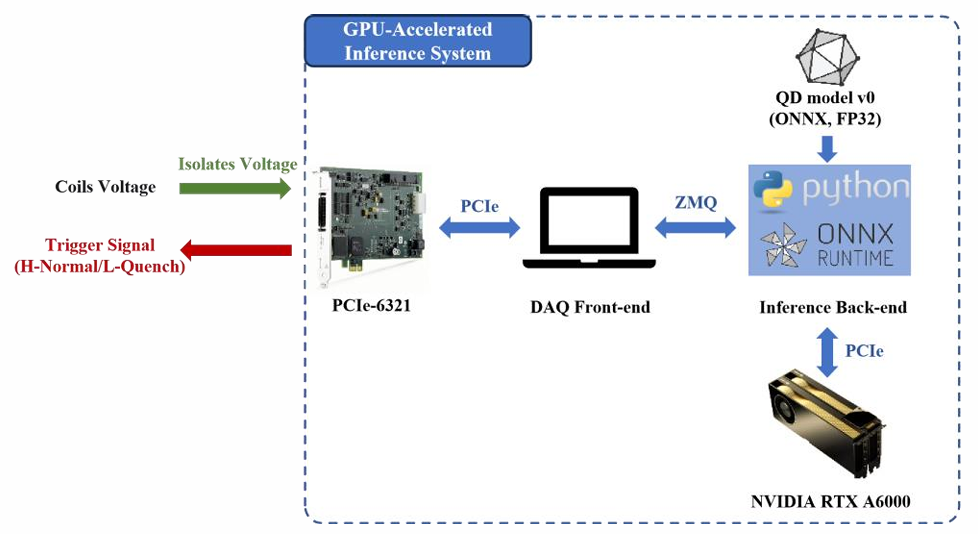
Figure. Artificial Intelligence Quench Detection System (AI-QDS) (Image from IMP)
Contact Information
Institute of Modern Physics
Email: LIU Fang
Related Articles

Copyright © Institute of Modern Physics, Chinese Academy of SciencesAddress:509 Nanchang Rd., Lanzhou 730000, ChinaEmail: office@impcas.ac.cn
陇ICP备2023003351号-1  甘公网安备 62010202000713号


