

Researchers Propose New Strategy to Develop Turing-patterned Nanofiltration Membrane for Water Treatment
Using ion-track-etched membranes obtained by heavy-ion irradiation and chemical etching, Chinese researchers have proposed a novel strategy that enables controllable fabrication of Turing-patterned polyamide nanofiltration membranes for water treatment.
The study, led by researchers from the Institute of Modern Physics (IMP), Chinese Academy of Sciences (CAS), was published in Chemical Engineering Journal.
Water scarcity and increasingly complex water compositions pose challenges for water treatment. With the advantage of low energy consumption, nanofiltration technology is widely used in wastewater reclamation, brackish water softening, and industrial water treatment.
Conventional nanofiltration membranes rely on interfacial polymerization (IP) to form polyamide selective layers. However, the surfaces of polyamide nanofiltration membranes mostly have disordered nodular structures. A long-standing permeability-selectivity trade-off remains a major challenge: high permeability and high selectivity are difficult to achieve simultaneously.
Turing-patterned nanofiltration membranes are regarded as a promising solution. Turing structures are periodic self-organized morphologies spontaneously formed by reaction-diffusion instability. Their unique ridge-valley structure can increase the effective permeation area of the membrane while preserving the intact crosslinked network of the selective layer. However, precise and controllable preparation of Turing-patterned membranes has remained difficult.
The researchers at IMP took advantage of ion-track-etched membranes with uniform and precisely tunable pore sizes. By combining the intrinsic exothermic nature of interfacial polymerization with the structure of ion-track-etched membranes, they achieved controllable fabrication of nanofiltration membranes with Turing structures.
According to the study, the discrete nanopores of the ion-track-etched membrane alter the heat dissipation at the reaction interface. The monomer concentration field couples with the thermal field, jointly inducing thermally coupled reaction-diffusion instability and spontaneously forming Turing ridge-valley morphology. The whole process requires no additional nanoparticles or polymer additives, achieving additive-free construction of Turing structures.
The researchers further established a thermally coupled reaction-diffusion theoretical model, revealing the rules governing Turing pattern formation. They found that the diffusion contrast of the reacting species determines the pattern morphology, while the absolute rates of mass and thermal transport determine the characteristic feature size.
By optimizing key parameters, researchers achieved precise regulation of the Turing structure. The obtained nanofiltration membrane exhibited a highly crosslinked network and a strongly negatively charged surface. It also achieved removal rates above 98% for five representative organic micropollutants, including bisphenol A, norfloxacin and ofloxacin. Moreover, the membrane showed favorable antifouling ability and maintained stable performance during 168 hours of continuous filtration.
The work not only offers a new additive-free route for developing high-performance nanofiltration membranes, but also provides theoretical support for designing new separation membranes for drinking water safety, industrial wastewater treatment and wastewater resource recovery.
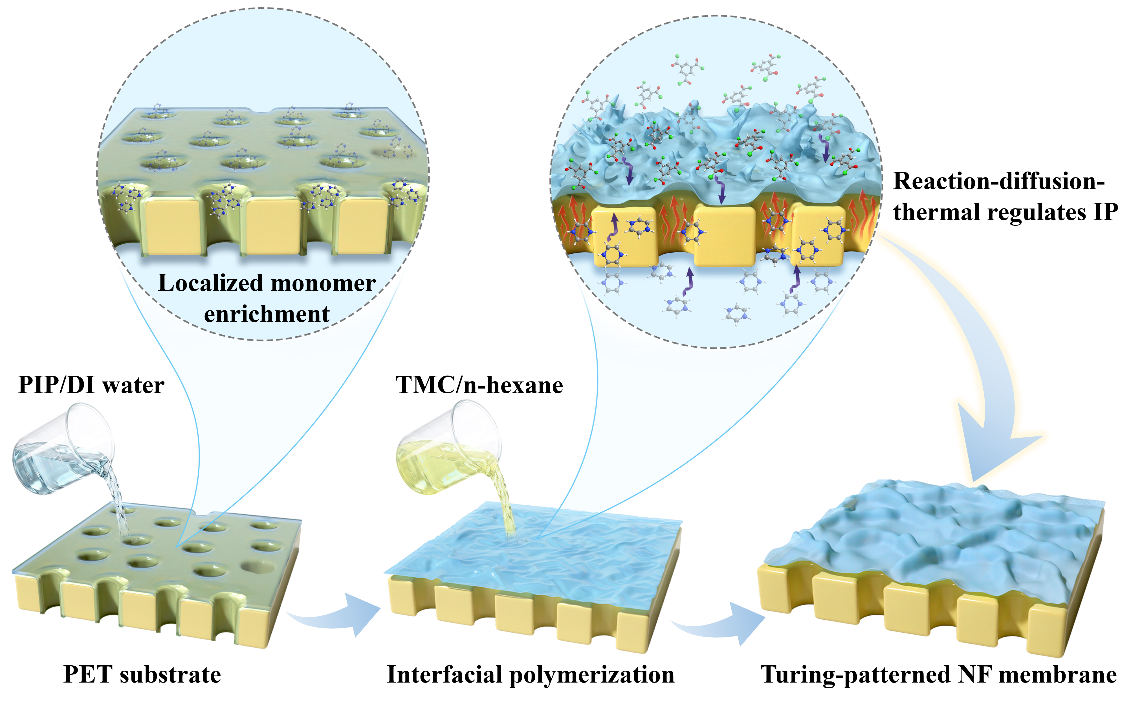
Figure. Schematic of the nanopore-mediated reaction-diffusion-thermal coupling strategy for fabricating Turing-patterned polyamide nanofiltration membranes. (Image from IMP)
DOI: https://doi.org/10.1016/j.cej.2026.182548
Contact Information
Institute of Modern Physics
Email: LIU Fang
Related Articles

Copyright © Institute of Modern Physics, Chinese Academy of SciencesAddress:509 Nanchang Rd., Lanzhou 730000, ChinaEmail: office@impcas.ac.cn
陇ICP备2023003351号-1  甘公网安备 62010202000713号


