

Study Provides Effective Strategy for High-value Utilization of Olive Pomace
Recently, researchers from the Institute of Modern Physics (IMP), Chinese Academy of Sciences (CAS), have made progress in enhancing lignin degradation and nutrient absorption in olive pomace (OP), as well as elucidating the underlying mechanisms. The findings have been published in Journal of Cleaner Production.
OP is rich in organic matter and essential plant nutrients, including nitrogen, phosphorus, and potassium, giving it considerable potential for agricultural utilization. However, phenolic compounds, terpenoids, and other allelochemicals present in OP not only inhibit the fermentation of composting microorganisms, but may also hinder plant growth, representing a major bottleneck for its direct application.
To address this challenge, the researchers at IMP employed heavy-ion mutagenesis combined with functional screening to obtain six strains with strong adaptability to OP substrates and enhanced capabilities for lignocellulose degradation and nutrient transformation. Through multi-strain synergistic fermentation, an olive pomace microbial organic fertilizer (OPMOF) was developed, containing up to 75% OP as the primary substrate.
Experimental results demonstrated that microbial fermentation substantially improved fertilizer quality. Compared with OP, OPMOF showed a three-order-of-magnitude increase in functional microbial abundance. Meanwhile, lignin and total phenolic contents were reduced by 59% and 65%, respectively, significantly improving nutrient availability and fertilizer safety. Compared with commercial organic fertilizer, OPMOF increased the aboveground fresh biomass of Brassica chinensis by 27.5% and significantly enhanced root activity and nutrient uptake capacity.
Mechanistic analysis further revealed that OPMOF enriched functional microorganisms, thereby promoting soil nutrient transformation. Meanwhile, OPMOF increased the abundance of soil Gram-negative bacteria and enhanced the production of the quorum-sensing signal molecule, promoting lateral root development and expanding root nutrient acquisition capacity.
In addition, the researchers demonstrated that ursolic acid, a characteristic bioactive compound in olive pomace, exhibits a concentration-dependent dual regulatory effect. At low concentrations, ursolic acid promoted the expression of genes associated with the root respiratory chain and enhanced Adenosine Triphosphate (ATP) synthesis, thereby promoting plant growth; however, high concentrations exerted inhibitory effects. This bidirectional regulatory pattern was further validated in rice and wheat experiments.
This study provides an effective strategy for the high-value utilization of agricultural wastes rich in allelochemicals and offers a theoretical basis for developing plant growth regulators from allelochemicals.
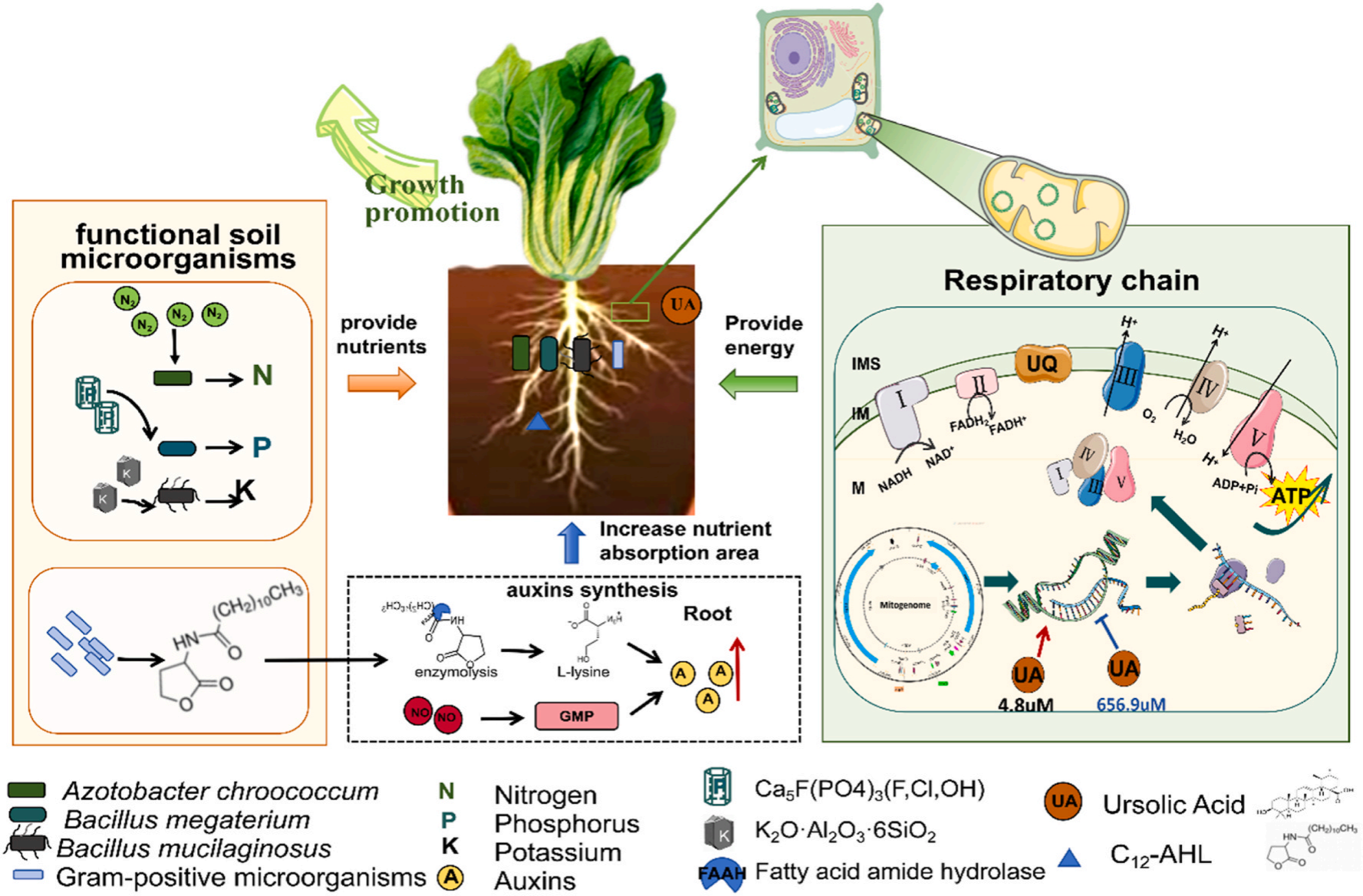
Fig 1. The mechanism of OPMOF in promoting nutrient transformation, absorption, and yield enhancement through the allelopathy of ursolic acid and microbial metabolism. (Image from IMP)
This work was supported by the Innovative Consortium Projects of Longnan City, the Gansu Provincial State-owned Assets Supervision and Administration Science and Technology Project, the National Natural Science Foundation of China, and other funding programs.
DOI: https://doi.org/10.1016/j.jclepro.2026.148774
Contact Information
Institute of Modern Physics
Email: LIU Fang
Related Articles

Copyright © Institute of Modern Physics, Chinese Academy of SciencesAddress:509 Nanchang Rd., Lanzhou 730000, ChinaEmail: office@impcas.ac.cn
陇ICP备2023003351号-1  甘公网安备 62010202000713号


