

HIAF Achieves First Physics Result with Hafnium-153 Observation
Chinese researchers have observed an extremely rare isotope, hafnium-153, utilizing the High Intensity heavy-ion Accelerator Facility (HIAF). This is the first physics result obtained during the commissioning phase of HIAF, demonstrating the facility's capability for pushing the boundaries of the nuclear landscape.
Published in Science Bulletin as a short communication, the research was led by the State Key Laboratory of Heavy Ion Science and Technology, the Institute of Modern Physics (IMP) of the Chinese Academy of Sciences (CAS), in collaboration with the University of CAS, GSI Helmholtzzentrum für Schwerionenforschung, the University of Cologne, East China University of Technology, and the Advanced Energy Science and Technology Guangdong Laboratory.
Atomic nuclei are composed of protons and neutrons, and different combinations of these particles form a diverse nuclear landscape. Exploring unknown isotopes and probing the limits of nuclear existence are among the important frontiers of nuclear physics.
Located in the neutron-deficient heavy nuclear region, hafnium-153 offers a unique window into the evolution of nuclear structure and the limits of nuclear stability. Its observation and precise measurement provide critical experimental information for testing nuclear models and advancing our understanding of nuclear structure.
In this experiment, a bismuth-209 primary beam, provided by the Booster Ring (BRing) of HIAF, was delivered onto a graphite target to produce radioactive nuclei through projectile fragmentation reactions. The cocktail beam was purified and transported by the HIgh rigidity Radioactive Ion Beam Line (HIRIBL) before being injected into the Spectrometer Ring (SRing), where the isochronous mass spectrometry technique was employed for precision measurements.
Despite an extremely low production cross section, the researchers observed a total of ten hafnium-153 ions. The results indicate that hafnium-153 is a bound or weakly bound isotope, consistent with predictions from various nuclear mass models.
Concurrently, the Radioactive Isotope Beam Factory (RIBF) in RIKEN, Japan independently reported the observation of hafnium-153. These two independent measurements provide mutual confirmation and further highlight the significance of this isotope in nuclear physics research.
The successful detection of hafnium-153 showcases the integrated capabilities of HIAF. The high-intensity heavy-ion beams enhance the production of rare isotopes, the high-performance HIRIBL enables efficient separation of the nuclei of interest, and the SRing's isochronous mass spectrometry technique provides single-ion sensitivity for precise identification and measurement of rare nuclei.
The observation of hafnium-153 not only marks an important advance in probing the limits of nuclear existence but also signals the beginning of a much broader scientific journey at HIAF.
Located in Huizhou, in South China's Guangdong Province, HIAF is a world-class next-generation heavy-ion accelerator that began trial operations on July 21. With continued enhancement of beam intensity and experimental efficiency, HIAF is expected to play an increasingly important role in discovering new isotopes and investigating nuclear properties under extreme conditions.
The research was supported by the National Key Research and Development Program of China, the HIAF project, the Youth Innovation Promotion Association of CAS, the National Natural Science Foundation of China, the Talent Support Project of Guangdong Program, and the Science and Technology Research Foundation of Gansu Province.
DOI: https://doi.org/10.1016/j.scib.2026.06.056
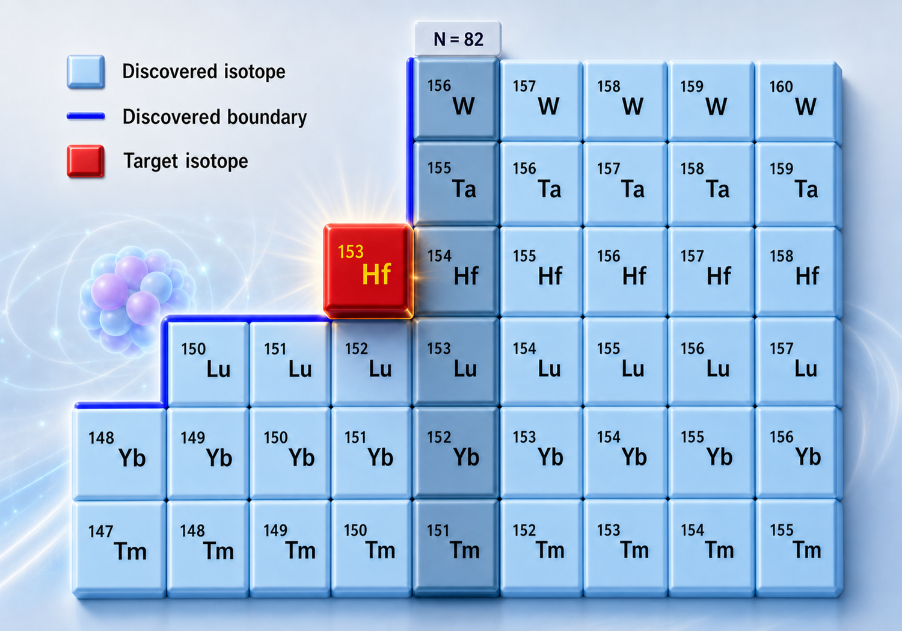
Figure 1. Location of hafnium-153 on the nuclear chart. Blue lines show the boundaries of the known nuclides around it. (Image by HU Houyu and LI Hongfu)
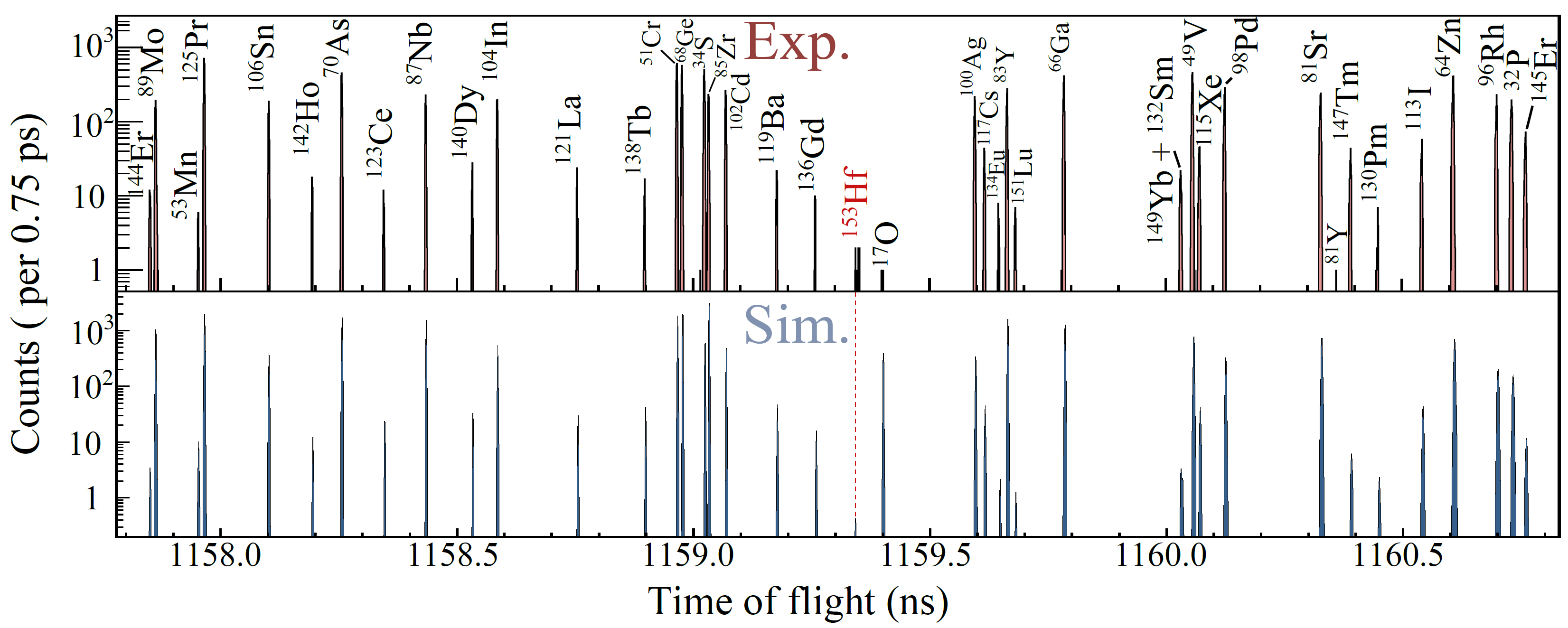
Figure 2. Comparison of experimental and simulated revolution-time spectrum of the stored ions in SRing. The single additional peak located at a revolution time of 1159.348 ns, marked by the red label, is assigned to hafnium-153. (Image by IMP)
Contact Information
Institute of Modern Physics
Email: LIU Fang
Related Articles

Copyright © Institute of Modern Physics, Chinese Academy of SciencesAddress:509 Nanchang Rd., Lanzhou 730000, ChinaEmail: office@impcas.ac.cn
陇ICP备2023003351号-1  甘公网安备 62010202000713号


