
Researchers Propose New Method for High-accuracy Measurement of Isotope Abundance
Chinese researchers have developed a novel two-dimensional coincidence time-of-flight mass spectrometry method for the precise measurement of isotopic abundance. The study was featured as the cover article of theJournal of the American Society for Mass Spectrometry.
Stable and long-lived isotopes, widely present in nature, serve as important natural tracers for studying astrophysical elemental abundances, archaeological chronology, and environmental processes in the atmosphere, hydrosphere, and pedosphere. Currently, the recommended values for isotopic abundances are derived from extensive experimental data accumulated over nearly a century, published by the International Union of Pure and Applied Chemistry (IUPAC) and the International Atomic Energy Agency (IAEA).
However, as research in astrophysics, archaeology, and environmental science increasingly demands higher precision in isotopic abundance measurements, the limitations of existing data in terms of accuracy and traceability have become apparent.
"Traditional techniques, including accelerator mass spectrometry, nuclear magnetic resonance, and various commercial high-precision mass spectrometry methods, are generally constrained by systematic errors that are difficult to eliminate entirely," said Dr. ZHANG Ruitian from the Institute of Modern Physics (IMP) of the Chinese Academy of Sciences (CAS), the first author of this study. "These include complex instrumental responses, sample preparation challenges, and unavoidable background contamination."
In this study, the researchers introduced a new approach based on the fundamental mechanism of molecular Coulomb explosion fragmentation. Using carbon monoxide molecules as a demonstration, they successfully achieved highly accurate measurements of the natural abundances of carbon-13 and oxygen-18.
Experimental results show that this method effectively eliminates systematic errors, enables clear discrimination between different isotopes, and achieves an accuracy better than 0.02%. This represents a significant improvement in the reliability of isotopic abundance measurements.
The study provides a new experimental method for obtaining high-precision, traceable elemental abundance data. "This two-dimensional mass spectrometry method is expected to have broad application prospects in fields such as nuclear astrophysics, paleoclimate reconstruction, archaeology, and environmental tracing," ZHANG added.
The study was conducted by researchers from IMP, Beijing Normal University, Shenzhen Technology University, and Tianjin University.
Link to the paper: https://pubs.acs.org/doi/10.1021/jasms.5c00373
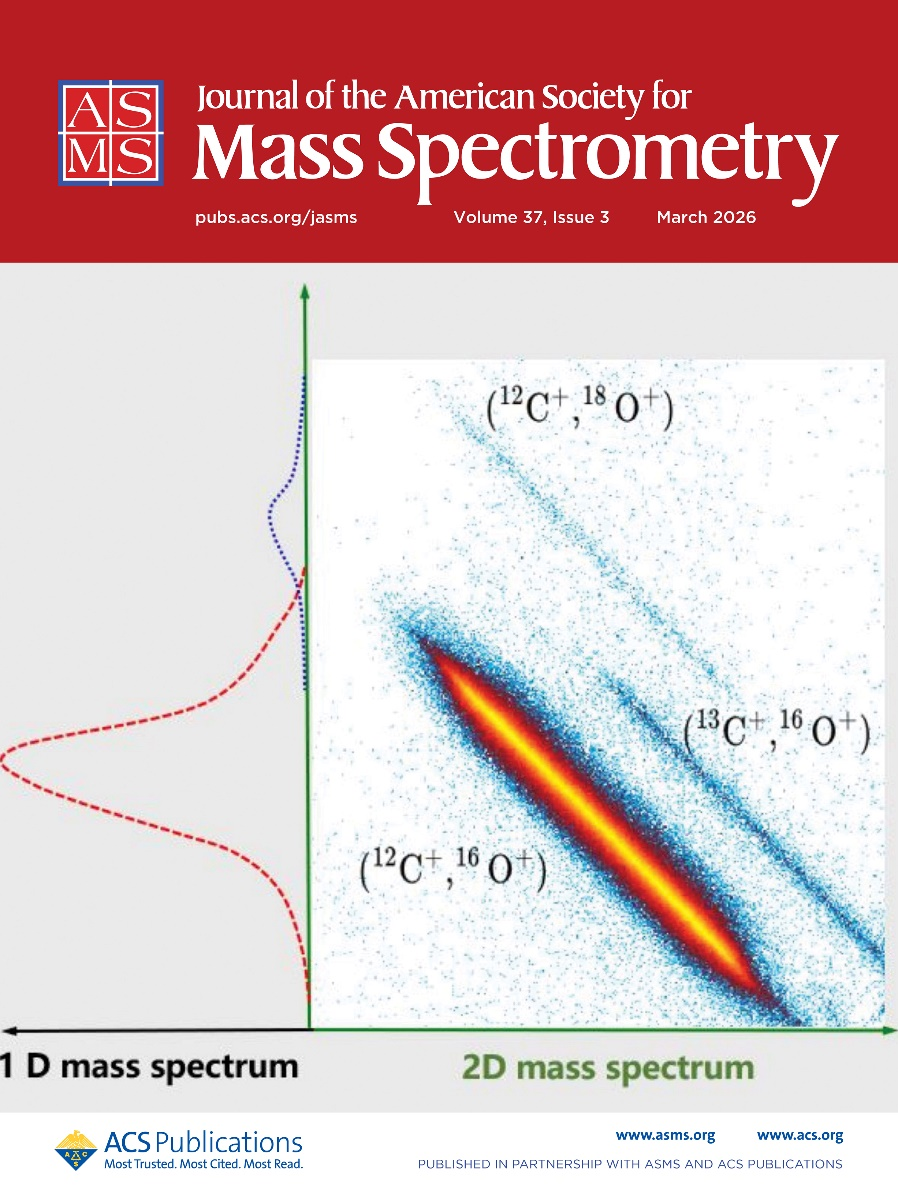
Figure. The study was published as a cover article. (Image from the Journal of the American Society for Mass Spectrometry)
Contact Information
Institute of Modern Physics
Email: ZHANG Ruitian
Related Articles

Copyright © Institute of Modern Physics, Chinese Academy of SciencesAddress:509 Nanchang Rd., Lanzhou 730000, ChinaEmail: office@impcas.ac.cn
陇ICP备2023003351号-1  甘公网安备 62010202000713号


