

Physicists Observe Rare Nuclear Isomer in Ytterbium-150 for First Time, Advancing Nuclear Structure Research
Nuclear isomers are crucial probes for studying the structure of nuclei. Unlike chemical isomers—which have the same chemical formula but different arrangements of atoms—nuclear isomers are nuclei that exist in a long-lived and relatively stable excited state.
Normally, an atomic nucleus resides in its lowest-energy state, known as the ground state. Under external perturbations, such as nucleus–nucleus collisions, however, a nucleus can be excited to a higher-energy state. While most excited nuclear states are extremely short-lived and rapidly decay back to the ground state, some nuclei remain "trapped" in an excited state for a remarkably long time. Such isomeric states help reveal the structure of the nucleus due to its high sensitivity to the underlying shell structure as well as to changes in single-particle levels.
Scientists have long noted a striking isomeric chain on the nuclear chart. Along this chain, isomers with spin-parity 10+ occur consecutively in 12 even–even nuclei, from the neutron-rich palladium-126 to the neutron-deficient erbium-148, giving rise to the longest 10+ isomeric chain on the nuclear chart. This phenomenon has raised an intriguing question unanswered for 40 years: Does this isomeric chain extend even further into the proton drip line region?
To explore this question, researchers from the Institute of Modern Physics (IMP) of the Chinese Academy of Sciences (CAS) and their collaborators conducted an experiment at the Accelerator Laboratory of the University of Jyväskylä in Finland, utilizing the gas-filled recoil separator RITU and the GREAT spectrometer.
Through their research, the physicists observed an isomer in the rare, extremely neutron-deficient nucleus of ytterbium-150 for the first time, leading to the identification of a unique "isomeric relay" mechanism that advances our understanding of nuclear structure.
The findings were published in the journal Physical Review Letters on February 26.
During the experiment, ytterbium-150 nuclei were produced and then transported to the focal-plane detector system for high-sensitivity delayed γ-ray spectroscopy. The researchers identified the 10+ isomer in ytterbium-150, measured its half-life to be 0.62 μs, and established its complete decay scheme.
Through theoretical calculations, the researchers revealed changes in the underlying configuration of nuclei within the 10+ isomeric chain—termed an "isomeric relay" mechanism. Specifically, the study showed that around proton number Z = 64, the configuration of these isomers shifts from a two-neutron configuration to a two-proton configuration. This relay enables the chain to extend further into the proton drip line region, underpinning the persistence of the 10+ isomeric chain.
The findings deepen our understanding of nuclear structure and provide critical experimental evidence for elucidating isomer formation mechanisms in the proton drip line region.
This work was supported by the National Natural Science Foundation of China, the Strategic Priority Research Program of CAS, and the National Key R&D Program of China, among other funding sources.
DOI:https://doi.org/10.1103/6cjc-bhfg
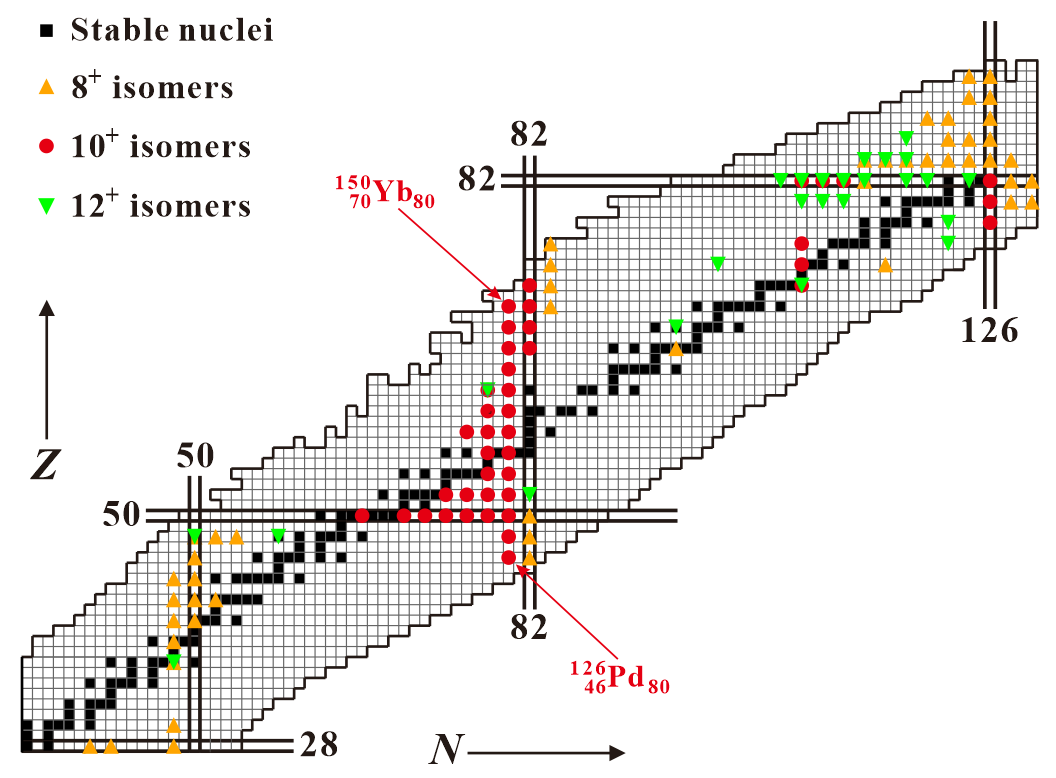
Figure 1. Occurrence of 8+, 10+, and 12+ isomers on the partial nuclear chart. (Image from Physical Review Letters)
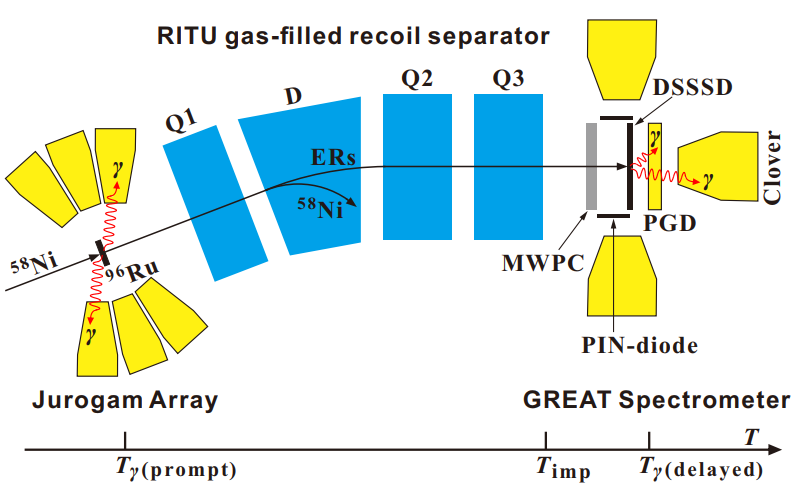
Figure 2. Schematic view of the setup in the experiment. (Image from Supplemental Material of Physical Review Letters)
Contact Information
Institute of Modern Physics
Email: LIU Fang
Related Articles

Copyright © Institute of Modern Physics, Chinese Academy of SciencesAddress:509 Nanchang Rd., Lanzhou 730000, ChinaEmail: office@impcas.ac.cn
陇ICP备2023003351号-1  甘公网安备 62010202000713号


